
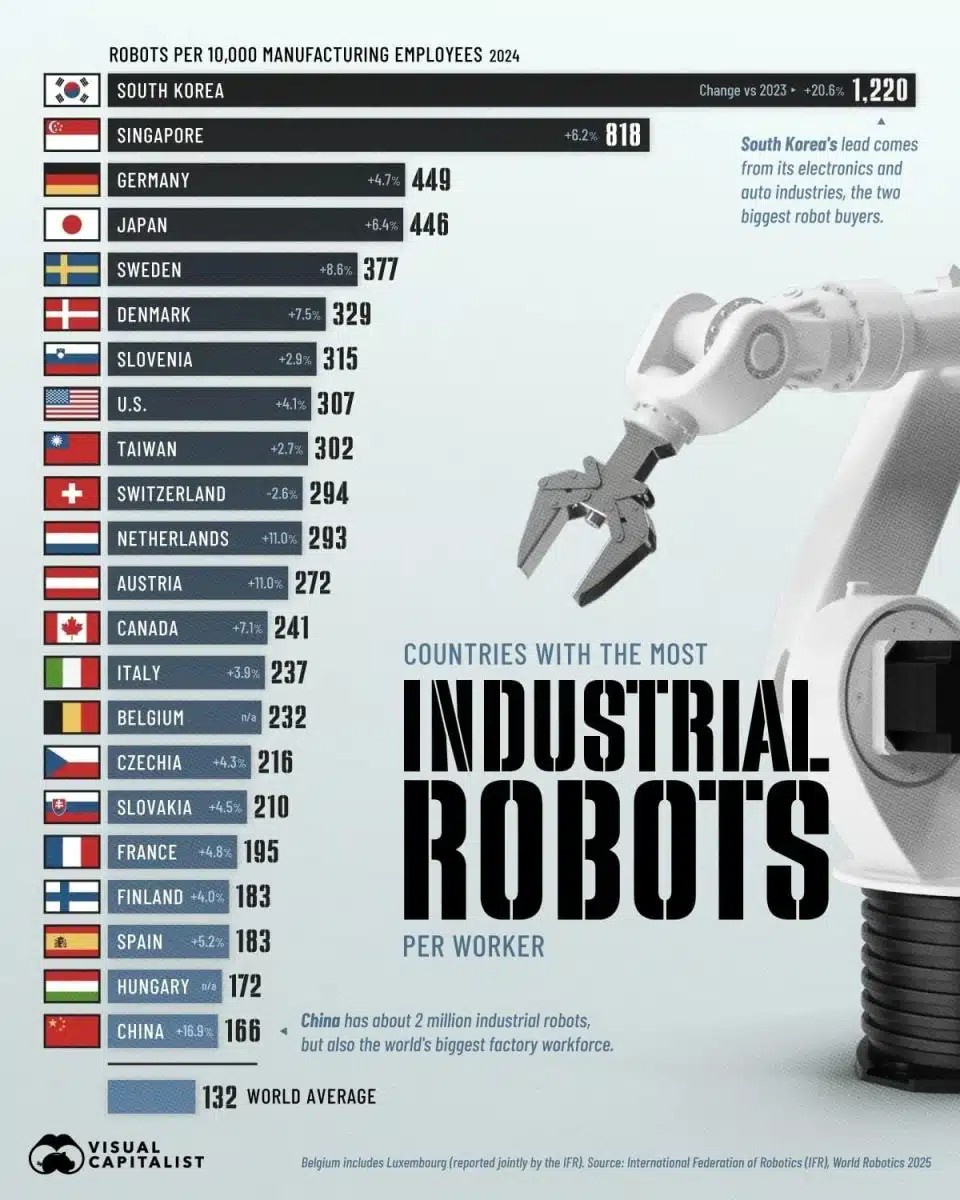
The infographic shows 22 economies with the highest levels of production robotization. The robotization indicator is the number of active industrial robots per 10,000 manufacturing workers in 2024. The data was published by the International Federation of Robotics (IFR) in April 2026.
South Korea and Singapore are noticeably ahead of the rest of the countries in the ranking. In both economies, a high level of automation is combined with a relatively small number of workers in the industrial sector.
In South Korea, there are 1,220 robots per 10,000 manufacturing workers, more than nine times the global average of 132 robots. In Singapore, this figure is 818 robots, which is almost double the result of Germany, which took third place (449). naked-science.ru.
South Korea has a world-renowned electronics industry and a large automotive sector. These two industries are the largest consumers of industrial robots in the world, accounting for almost half of all new installations in 2024. An additional factor stimulating automation is the demographic situation. In 2025, the total fertility rate in South Korea was 0.75 children per woman, one of the lowest rates in the world. As a result, manufacturers are facing a reduction in the available workforce.
The situation is similar in Singapore, a small country with a relatively small number of manufacturing workers. The fertility rate here is also below the one child per woman mark and is 0.96.
China shows the opposite picture. In 2024, about two million industrial robots were in operation in the country — about 43% of the total global fleet. However, due to the huge number of manufacturing workers, there were only 166 robots for every 10,000 employees.
European countries occupy 15 out of 22 places in the ranking of economies with the highest density of industrial robots. This is largely due to the developed automotive industry.
This dependence is particularly noticeable in Central Europe, which is represented by four ranking countries: Slovenia — 315 robots per 10,000 employees, Czech Republic — 216, Slovakia — 210 and Hungary — 172.
According to the International Organization of Automobile Manufacturers (OICA), Slovakia produced 183 cars per 1,000 inhabitants in 2024, the highest rate in the world and more than three times higher than in Germany, where it was 51 cars.
In the Czech Republic, where Škoda Auto's headquarters and production facilities are located, as well as Hyundai and Toyota plants, 134 cars per 1,000 inhabitants were produced in 2024.