
Central Asia’s proposal for the food system of the future
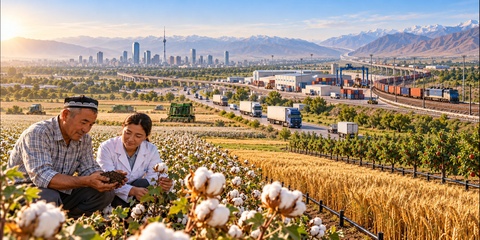
Behind the bread, fruit, milk, and fish on a family’s table lies a chain of work and knowledge that stretches from seed to market. The proposal to see Central Asia as a shared food basket begins by connecting those chains. Presented by Uzbekistan at FAO’s 2026 World Food Forum, the initiative brings the region’s strengths in agriculture, science, nutrition, investment, and logistics together around a common purpose.
The World Food Forum is an international platform where youth initiatives, science, innovation, and investment meet. Countries bring their solutions to global food security. We proposed presenting Central Asia’s strengths as a connected whole: a shared food basket, a land-linked regional system, and a 7D model to put that vision into practice.
At the heart of the proposal is a simple but strategic idea. Central Asian countries have limited access to maritime routes, yet they are connected by land. That proximity can become an advantage, bringing production, science, logistics, and markets together. Each country’s strengths need a place in the shared chain.
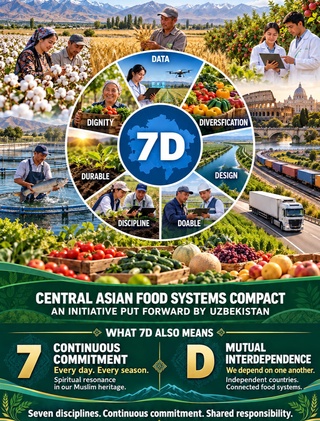
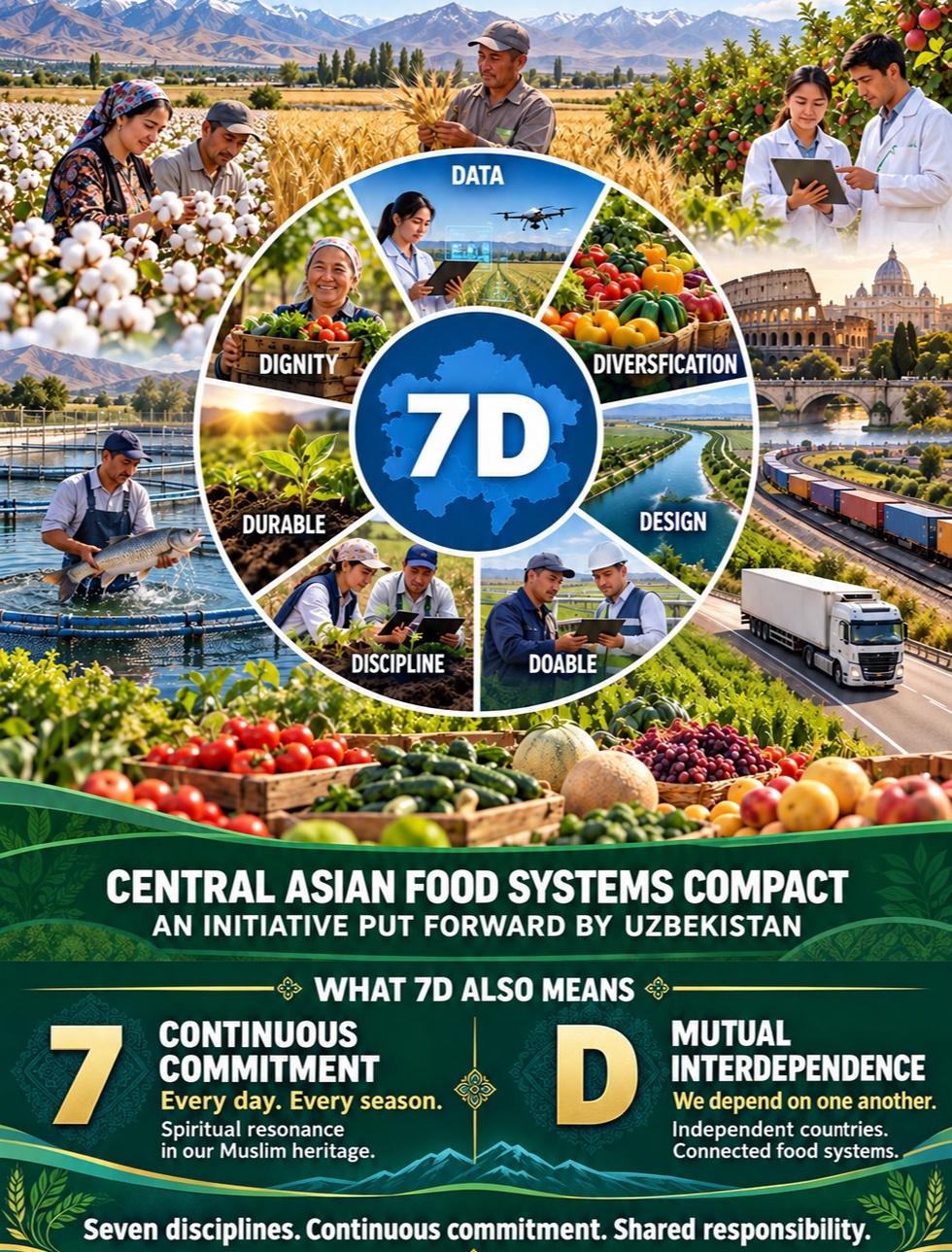
This is the purpose of the proposed Central Asian Food Systems Compact: a regional framework for food-systems cooperation. Its practical foundation rests on seven Ds: Data, Diversification, Design, Doable, Discipline, Durable, and Dignity. Together, they stand for reliable information, diversity, well-designed systems, workable solutions, disciplined implementation, lasting results, and human dignity. The principles are meant to work together and reinforce one another.
The approach sparked discussion among forum participants. Those conversations also explored how to adapt it to the circumstances of other landlocked countries and countries of the Global South. Practical cooperation beginning in Central Asia could therefore provide a basis for a wider exchange of experience.
The meaning behind 7 and D
Seven symbolizes continuity in this initiative. Just as the week has seven days, attention to food security must continue from week to week, season to season, and generation to generation. This is not a call for people to work without rest. It is about dependable institutions that sustain food supplies, scientific monitoring, and essential services, along with lasting agreements and the responsibility to see work through.
Seven also holds a special place in Muslim spiritual heritage. Verse 3 of Surah Al-Mulk in the Qur’an refers to seven heavens. Tawaf consists of seven circuits around the Kaaba. For me, that spiritual connection reminds me of perseverance, responsibility, and finishing what we begin. In this sense, seven expresses an initiative grounded in daily work and moral responsibility.
D is the first letter of each of the seven principles. We also give it the symbolic meaning of “depend on one another.” Our countries are independent, and our food systems are interconnected. Water, energy, harvests, or transportation in one area can affect farmers and consumers across the border. That interdependence calls for reciprocal responsibility.
In Central Asia, this responsibility has a concrete foundation. Water management affects energy generation, irrigation, and harvests, while transportation delays affect farm incomes and market prices. Partners therefore need to agree in advance on tasks, cost and benefit sharing and measures of success. The seven principles help translate those connections into clear commitments and benefits for each side.
Regional strengths that complement one another
Central Asian countries differ in their natural conditions, productive capacity, and agricultural experience. The strength of a shared food basket lies in that diversity. When one country’s knowledge, resources, or products meet a neighbor’s needs, separate strengths become mutually beneficial cooperation.
Kazakhstan has vast grain-growing areas, oilseed production, livestock farming, and transit capacity. Kyrgyzstan brings mountain pastures, livestock, water resources, and small farms. Tajikistan brings experience in mountain agriculture, fruit growing, and water management. Turkmenistan brings experience in farming in arid conditions, livestock, and transit opportunities. Uzbekistan combines intensive agriculture, cotton production, fruit and vegetable farming, science, processing, and a large market in a densely populated country.
A shared food basket takes shape when these strengths connect within one system. Seeds or technologies developed in one country must reach farmers in another. Scientific findings need to be tested in the field, and produce needs access to storage and refrigeration. It must then cross borders without unnecessary obstacles and reach consumers in good condition. The farmer’s work needs to be valued throughout the route.
Being connected by land therefore involves much more than roads and railways. It also requires common standards, safeguards for plant and animal health, water and climate data, science, digital traceability, finance, cold chains, and processing. A road moves a product; a reliable system preserves its quality and economic value. This is how cooperation turns geographic proximity into a practical advantage.
1D Data: Decisions grounded in reliable information
The first D is Data. Planning regional cooperation requires reliable information about what each area produces, how water shortages are changing, and which varieties suit local soils and climates. Nutritional needs, market price differences, and farmers’ costs and incomes fit into the same picture. Knowing where a harvest is abundant, for example, must go hand in hand with knowing where to store it and which market to serve.
That need led to the proposal for a regional Food Basket Observatory. It could bring together comparable data on production, water, soil, nutrition, trade, logistics, and farm economics. Such analysis would help direct investment to where it is needed, identify risks earlier, and assess the results of cooperation. For Blue Nutrition, we also need to study the nutrient composition of fish and other aquatic foods, their affordability, and how readily people can obtain them.
Each country would retain control over its own data. Partners would agree on the indicators, units of measurement, and analytical methods needed for shared decisions. Artificial intelligence could help analyze the information, but its outputs must be understandable, verifiable, and tested under local conditions. People remain responsible for the final decisions and their consequences.
2D Diversification: Diversity as the foundation of resilience
The second D is Diversification. This means broadening the range of crops, varieties, technologies, products, markets, funding sources, and partners. When difficulties arise in one area, other options must keep working, for both the farmer and the region. Diversity therefore strengthens a food system's resilience.
Its simplest expression is on the family table. Grain remains a foundation of food security, while a well-rounded diet also requires fruits, vegetables, legumes, potatoes, meat, milk, eggs, and fish. Diverse production needs to support healthy diets and income sources in rural communities.
This is where Blue Nutrition, the concept of improving diets through fish and other aquatic foods, becomes particularly relevant. Central Asia faces constraints in bringing marine foods regularly to family tables. Without direct access to the open sea or ocean, transporting, refrigerating, and storing them becomes more difficult. Our countries need to address this challenge together.
At the same time, we need a deeper understanding of the nutritional value of the fish we raise locally. Iodine, omega-3 fatty acids, and other nutrients vary among freshwater and marine fish, depending on the species, feed, and farming conditions. Meeting people’s nutritional needs therefore requires attention to fish composition, the variety of foods on the table, and production volume.
Two connected efforts are needed. In Central Asia, we should use the fisheries potential of reservoirs, rivers, canals, and farm ponds while protecting water resources and ecosystems. Alongside that work, we should expand joint Blue Nutrition programs with coastal countries. Cooperation could include exchanging scientific expertise and technology, studying product nutrient composition and supplying marine foods safely and affordably. Connecting fisheries and aquaculture with crop farming, feed production, refrigeration, veterinary services, biosecurity, and markets would improve access to protein-rich foods and other essential nutrients. Blue Nutrition can thus unite our countries around shared nutritional goals and connect regional cooperation with coastal partners.
The same logic applies to potato farming. Expanding planted area must be matched with healthy seed potatoes, local seed production, varieties suited to their growing areas, coordinated water and nutrient management, disease control, storage, and processing. A good harvest in the field will not deliver the income a farmer expects if storage loses quality.
Each new area of diversification should solve a specific problem, suit local water and soil conditions, and deliver practical results in markets or nutrition. A new product’s value lies in the opportunities it creates for farmers and consumers.
3D Design: Good results begin with a well-designed system
The third D is Design. A good idea needs careful organization. From the outset, partners must identify who will test the research findings, how farmers’ risks will be reduced, who will buy the product, when funding will be available, and how results will be assessed. This allows scientific work to connect with farmers, banks, and markets at the right time.
The Central Asian Food Systems Compact is intended to organize those connections. It should be a lean platform that brings existing national and regional institutions together around specific tasks. What matters is putting existing capacity to work toward a common goal rather than building a large new bureaucracy.
At the regional level, partners could coordinate common standards, cross-border water and climate risks, pest and disease measures, trade corridors, and investment projects. Practical work would take place in each country, locality, and farm. This arrangement lets countries address shared problems jointly while preserving national authority and local accountability.
4D Doable: A solution that works on the farm
The fourth D is Doable. In agriculture, a scientific advance does not complete its journey with a paper or a laboratory result. It needs to work in a local field, with the farmer’s labor and resources, under real market conditions. Science demonstrates its practical value when a farmer can use a solution and see the benefits on the farm.
This is why we proposed grants and financing mechanisms based on “proof of use,” or evidence of actual use. A grant would continue to support a solution beyond the research finding or prototype, helping researchers and farmers test and apply it together. The aim is to shorten the distance between science and its first user.
Once researchers develop the scientific mechanism and technology, they test the solution in local soils and climates. Farmers help assess costs, labor requirements, and risks. The team also examines product quality, potential buyers, and market opportunities. Evidence gathered at these stages provides a basis for attracting investment to expand its use.
Funding for the next stage depends on verified results from the previous one. Projects that do not deliver are assessed openly, revised, or stopped. There must be room to learn from honest scientific mistakes without hiding them. At the same time, years of funding must be justified by practical results.
The scientific foundations of this approach have been presented in Discover Sustainability. Its purpose is to create a continuous connection among scientists, farmers, and investors. Scientists develop a solution, farmers help assess its practical value, and investors make decisions based on verified results.
5D Discipline: Discipline is part of the technology
The fifth D is Discipline. Uzbekistan’s cotton sector has demonstrated its practical importance. Between 2021 and 2025, the cotton-growing area fell from 1,031,000 to 875,600 hectares. Over the same period, total seed cotton production, the harvested crop before ginning, rose 19.3 percent to nearly 4 million metric tons. Average yield increased from 3.24 to 4.55 metric tons per hectare. In other words, farmers could harvest more from less land. In 2026, average yield is expected to reach 5.2 metric tons per hectare, with total seed cotton production of 4.5 million metric tons.
Coordinated agronomic practices played a major role in that result. Eight rules for cotton production cover a healthy plant population, the right planting pattern, plant architecture management, balanced nutrition, timely management of crop maturity, integrated crop protection, operations carried out on schedule and in sequence, and an environmentally clean field. We call them rules because you must meet each requirement. Their effectiveness comes from the way they work together.
The seventh rule matters most: skipping one agronomic step can reduce the effectiveness of the practices that follow. The same applies to a regional food system. Quality standards, cold chains, border transit times, disease monitoring, and investment commitments must all be met on time. Fieldwork should not lose value because of a border delay or a break in refrigeration.
Uzbekistan’s eight rules can be adapted to other crops and conditions elsewhere in Central Asia and the Global South. The principles of a complete technology, timely implementation, and measurable results remain. Choose specific practices to suit each crop and location.
In this sense, discipline is part of the technology. A good solution delivers the expected benefits when it is carried out fully and on time.
6D Durable: Benefits that last from season to season
The sixth D is Durable. A high yield in one-year matters, but soil, water, and the farmer’s financial capacity must also be preserved for the seasons ahead. Results achieved by using excessive water, weakening the soil, or leaving a farm in debt will not last.
Turning cotton stalks into biochar offers one example of these connections. With suitable technology and under appropriate local conditions, biochar may help retain carbon and moisture in the soil and create additional value from organic residues. Where results can be verified and accounted for transparently, carbon markets may provide an additional income source. Consider soil, water, economics, markets, and people’s interests together.
First, establish the technology’s benefits for soil, yields, and farm economics. Carbon revenue should be an additional income stream built on those real benefits. The farm’s core economics should not depend entirely on future carbon credits.
Lasting results also depend on local specialists, services, seed production, spare parts, market demand, and multiyear financing. A project’s real test comes when outside funding ends. If local people can run it and see its economic benefits, it becomes sustainable.
7D Dignity: Human dignity at the center of reform
The seventh D is Dignity. Every agricultural technology ultimately affects people’s lives. Alongside tons, hectares, and export figures, we therefore need to see what changes in a farmer’s household, in rural life, and on the consumer’s table.
Higher farm incomes, lower risks, new opportunities for women and young people, and access to good-quality, healthy food are key measures of success. Listening to farmers and considering their interests when making technology decisions is another practical expression of Dignity.
This is where Uzbekistan's STEM+HECI approach is particularly relevant. STEM, science, technology, engineering, and mathematics, provides the knowledge needed to develop genetic, agronomic, and digital solutions. HECI, Humanity, Ethics, Creativity, and Imagination, helps direct that knowledge toward human well-being.
Science shows which solutions are possible. Humanity and ethics connect those possibilities with society’s needs and our responsibility to the future. Farmers should therefore actively help select, test, evaluate, and improve technologies. Their knowledge, labor, data rights and the risks they take must all be treated fairly.
Participation then goes beyond asking for an opinion. The farmer’s voice influences the decision, and the farmer’s interests and responsibilities are established alongside those of other participants. This is how human dignity takes practical form.
Farming informed by epigenetics
One of the initiative’s scientific priorities, farming informed by epigenetics, shows how the 7D principles can work together. This approach aligns a plant’s genetic potential with its environment and care.
A good variety holds considerable potential, but soil, temperature, water, nutrition, and management influence how that potential is expressed. Some environmental effects can also alter gene activity. Understanding seed condition before planting and the care it receives afterward therefore helps translate genetic knowledge into field value.
Uzbekistan has tested approaches including cold conditioning of wheat seed before sowing, matching varieties to growing areas, soil and water management, and balanced nutrition. Across comparable fields included in the 2026 national analysis, average yield reached 9.78 metric tons per hectare. This result demonstrates the practical importance of studying genetics and agronomy together.
That figure should not be treated as a ready-made guarantee for other fields. Each farmer’s soil, water, varieties, and practices differ. The central idea is to bring out the potential of good genetics through the right environment and care. Measure the results of every solution under local conditions.
Scientific trials across different varieties, soils, and climates should therefore precede expansion. The 7D model connects that process with data collection, local testing, calculation of the farmer’s benefits, and expansion based on verified results. This is how a scientific idea becomes a reliable practice that farmers can use.
Four shared missions
We proposed beginning the Central Asian Food Systems Compact with four shared missions. They should bring countries together around specific problems and measurable results, drawing on each nation’s scientific and practical capacity.
The first mission focuses on epigenetics-informed farming. The second uses Blue Nutrition to expand the role of fish and other aquatic foods in diets. It brings together local fisheries and aquaculture development, nutritional research, and cooperation with coastal countries to improve access to a wider variety of aquatic foods. The third develops land transport corridors connecting the field, storage, processing, transportation, and markets. The fourth is circular carbon farming, linking organic residues, biochar, soil health, and carbon revenue supported by verifiable results.
The missions share a common requirement: the scientific mechanism must be understandable, local trials reliable, and farm economics assessed, with safety, environmental effects, and market opportunities evaluated. When results are measured transparently, partners can decide on the next step together.
From seven proposals in Rome to results in the field
The seven proposals put forward in Rome aim to turn these ideas into a practical field-to-table chain. The Food Systems Compact was proposed as the foundation. Within it, countries could agree on shared goals, tasks, and each partner’s responsibilities.
Such cooperation needs reliable information. The proposed Food Basket Observatory would bring together data on water shortages, production volumes, nutritional needs, and transportation costs. Shared decisions could then take better account of needs, opportunities, and existing constraints.
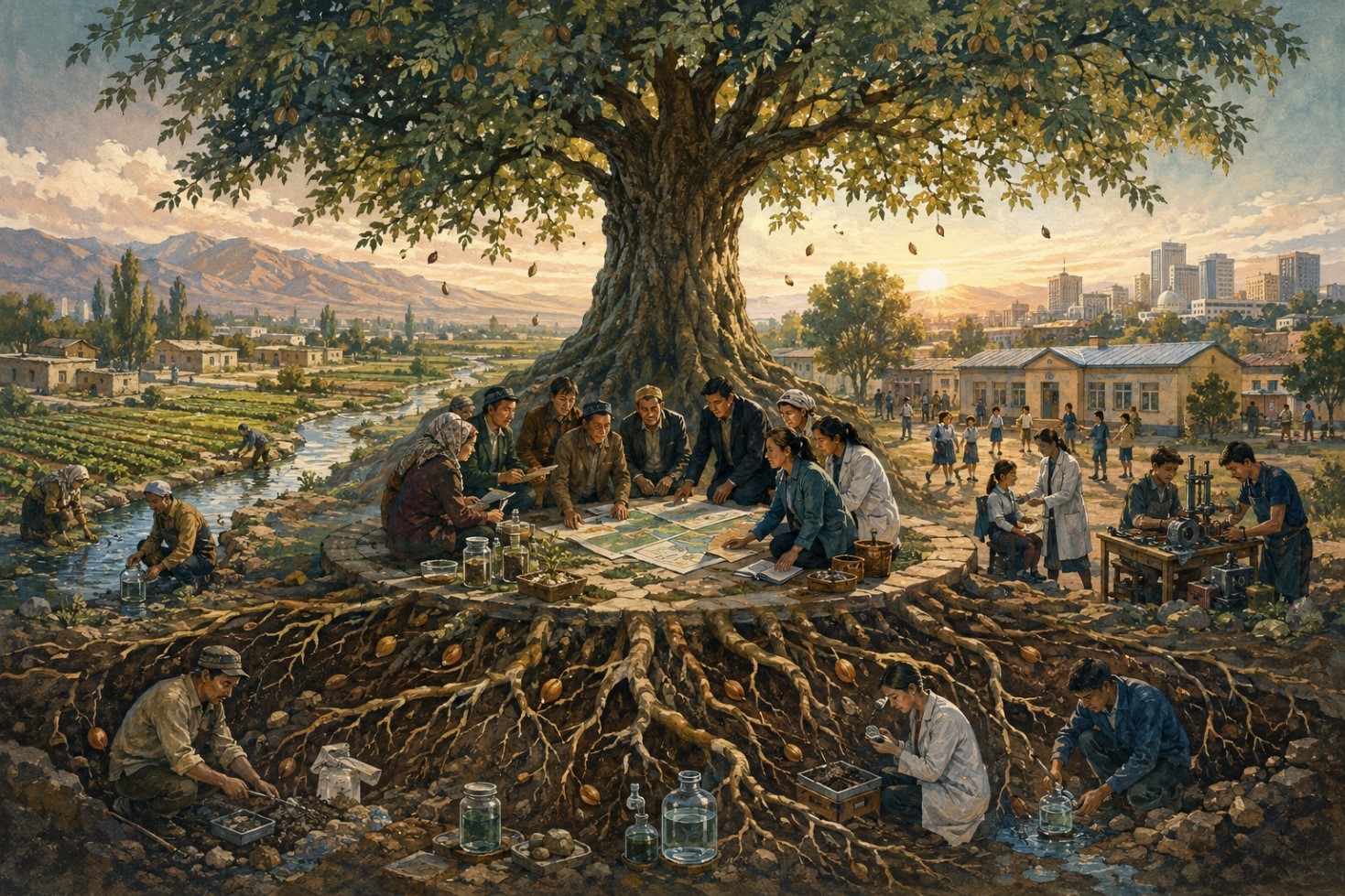
The next step is to test innovations with farmers. We proposed establishing 7D Living Labs in each country: practical testing sites where scientists and farmers work together. Regional proof-of-use financing would support solutions from the lab to real-world field use. An important outcome is that farmers can see the benefits themselves.
Joint scientific missions on epigenetics-informed farming and Blue Nutrition serve the same purpose. The first studies how genetics and agronomy work together. The second connects local fisheries and aquaculture, the nutritional value of aquatic foods, and cooperation with coastal partners to the goal of healthy diets. To store, process, and deliver products to markets, we also proposed a joint investment portfolio for land-linked food corridors. Uninterrupted refrigeration along these routes is especially important for fish and marine foods.
The people carrying this work forward also need strong connections. That is the purpose of the proposed STEM+HECI network of scientists, leaders, farmers, and young professionals. It should help them exchange knowledge, test local solutions together, and make decisions with people’s interests in mind.
Discussions showed interest in verifying results with farmers, aligning regional data, Blue Nutrition, and Living Labs. Uzbekistan offered its scientific capacity, field experience, testing sites, intensive farming, and processing capabilities for this cooperation. It offers experience to build on and a practical ground to test solutions.
From Central Asia to a world food basket
The 7D approach can also be adapted to other regions’ needs. Imagine a world food basket as a network of connected regional baskets. Each region contributes its natural resources, products, and knowledge. Cooperation should first support nutritious diets for local people and income for farmers, while products reliably reach markets where there is demand.
Consider an area that produces abundant fruits and vegetables but has limited storage. Alongside increasing harvests, it needs to coordinate warehousing, refrigeration, processing, transportation, and purchasing. Connecting a neighboring area’s capacity to that need could help reduce losses. The 7D model proposes designing the connection with data, testing it with farmers, and financing it according to results.
Priorities will differ elsewhere. In water-scarce areas, cooperation may focus on efficient water use; where products spoil quickly, refrigeration and processing may come first. Blue Nutrition connects the strengths of coastal and landlocked countries. Sustainable fisheries and aquaculture, trade that accounts for nutritional value, and reliable cold chains can make a variety of aquatic foods safe and affordable for consumers. Countries sharing a river basin or trade corridor can develop their own cooperation framework around these tasks. The underlying logic remains, while the practical solution grows out of local conditions.
In these programs, too, the seven principles work together. Countries agree on measurement and quality requirements, test solutions in their own conditions, and identify responsible institutions and funding sources. Each country retains national decision-making, while countries address cross-border matters through agreement. Fair cost and benefit sharing builds trust and helps cooperation endure.
Assess results through farm incomes, food affordability, dietary quality, water saved, and reduced losses, alongside exports and total harvests. If trials in Central Asia deliver reliable results on these measures, there will be a practical basis for sharing the experience with other regions. What travels is the experience of developing local solutions and testing them together.
Central Asia can thus contribute both products and a cooperative experience to a world food basket. Returning to the family table at the beginning of this article clarifies the initiative’s purpose. When a farmer’s harvest reaches the consumer, work becomes income, the table offers a richer diet, and water and soil are protected for future seasons; cooperation has served its purpose.
Ibrokhim Abdurakhmonov,
Minister of Agriculture of the Republic of Uzbekistan, Academician