
The Center for Economic Research and Reform applied satellite data on Nighttime Lights (NTL) to assess economic activity at the regional and urban levels in Uzbekistan.
Analysis of satellite data on night illumination shows that a higher intensity of illumination corresponds to a higher level of economic activity and urban infrastructure development.
The results of the CEIR analysis showed a high degree of consistency of satellite indicators with official statistics. In particular, according to estimates based on NASA night illumination data, in 2020-2025, the nominal growth of gross domestic product per capita in Uzbekistan amounted to 80.3%, which corresponds to an average annual growth of 15.8%. In 5 years, GDP has increased from $2,090 to $3,887.
For comparison, according to official statistics, GDP per capita grew by 81.8% over the same period, with an average annual growth of 16.1%, increasing from $2,048 to $3,881.
Economic activity of large and medium-sized cities
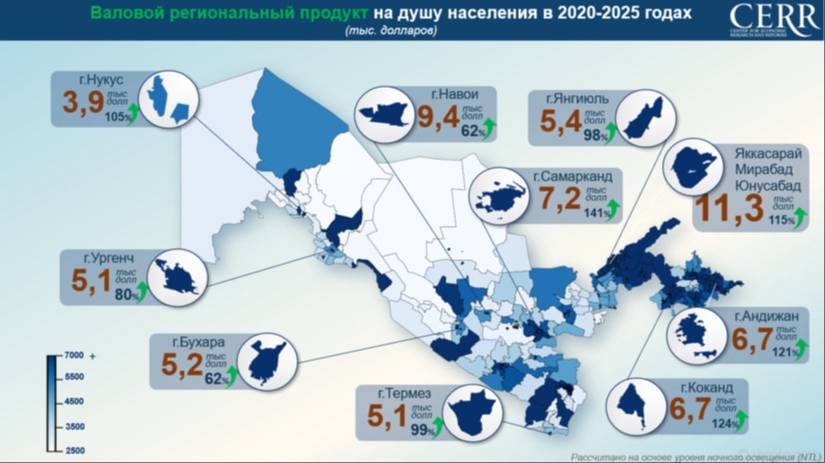
According to the data, over the past five years, the largest increase in the gross regional product per capita among the regions was recorded in the city of Tashkent, where the indicator increased by about 5 thousand dollars and by the end of 2025 amounted to 9.3 thousand dollars (according to statistics, 9.2 thousand dollars).
According to estimates, in 2025, the highest rates of gross regional product per capita were also observed in a number of large and medium-sized cities in the country. In Navoi, the NTL figure was 9.3 thousand dollars, in Zarafshan 7.9 thousand dollars, in Samarkand 7.2 thousand dollars, in Kokand and Andijan 6.7 thousand dollars each, in Akhangaran, Yangiyul and Bukhara from 5.8 thousand to 5.2 thousand dollars, respectively.
Also, relatively high growth rates of the gross regional product per capita were noted in a number of regions of the country. In the Tashkent region, the indicator increased by 1.8 thousand dollars and reached about 4 thousand dollars.
In the Navoi region, the growth also amounted to 1.8 thousand dollars, as a result of which the GRP per capita reached about 4 thousand dollars. In the Ferghana and Syrdarya regions, this figure increased by 1.6 thousand dollars and amounted to about 3.5 thousand and 3.4 thousand dollars, respectively.
Economic activity of small and medium-sized cities
Relatively high indicators of the gross regional product per capita are noted in a number of small and medium-sized cities. In Termez, the figure was 5.1 thousand dollars, in Margilan and Chirchik about 5 thousand dollars, in Namangan 4.8 thousand dollars. The level of economic activity also remains relatively high in the cities of Kagan and Urgench.
Economic activity at the district level
In terms of districts, the highest dynamics of GRP growth per capita in 2020-2025 was observed in Mirabad district, where the indicator increased by $7.1 thousand, in Yakkasaray by $6.3 thousand and in Chilanzar by $5.6 thousand. As a result, the level of GRP per capita in these areas exceeded 10 thousand dollars, which is almost 3 times higher than the average for other regions and cities of the republic.
Among the districts, the highest growth rates of economic activity were also noted in Karmaninsky district, where the indicator increased 2.5 times, Yashnabad and Bektemir districts 2.4 times, Sergeli, Yangi Khayot and Mirzo Ulugbek districts 2.3 times.
Expansion of territories with high economic activity
The use of night illumination data made it possible to assess the processes of urbanization at the district level. In particular, in the period 2020-2025, the number of territories with a high intensity of night illumination (HTL above 10), typical for urban agglomerations, increased from 22 to 31. At the same time, the average level of the gross regional product per capita in such territories increased from an average of 3.8 thousand dollars to 7 thousand dollars.
At the same time, over the past five years, the number of districts with low levels of night illumination (HTL below 1) has decreased from 129 to 85, which confirms the transition of 44 districts to the urban type of development.
In these areas, the NTL index increased by an average of more than 2.5 times, while the GRP per capita increased from an average of 1.7 thousand to 3.2 thousand dollars.
Conclusion
The results obtained confirm that satellite data on night illumination can effectively complement official statistics and be used to quickly assess the economic activity of regions.
This approach will make it possible to identify new points of economic growth and more specifically direct government support to the development of infrastructure and investment activity in the regions.