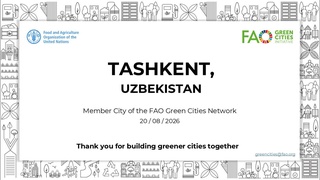

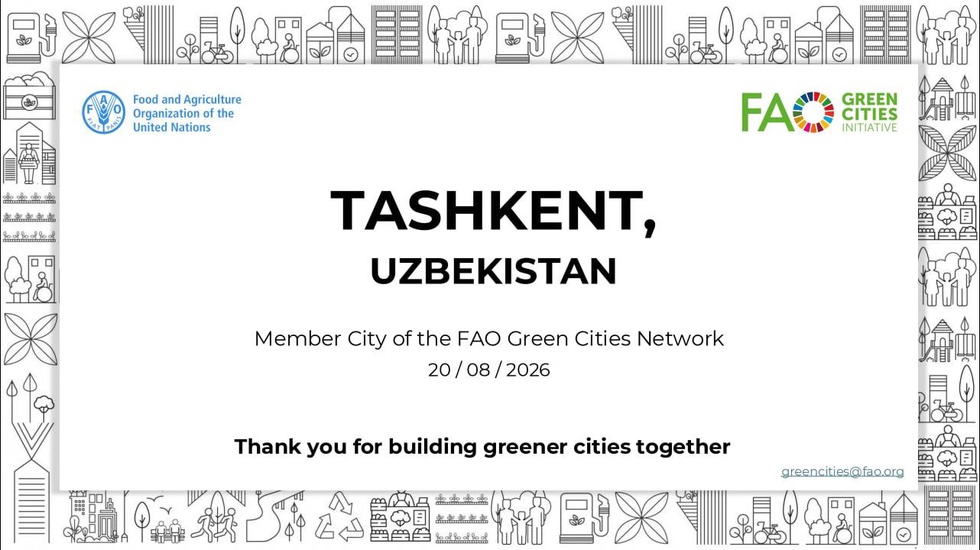
According
to the certificates issued on August 20, 2026, by the Secretariat of the FAO
Green Cities Initiative at the organization’s headquarters in Rome, Tashkent
and Samarkand are officially registered as member cities of the FAO Green
Cities Network.
By joining
the Network, the two cities became part of a global community of cities
collaborating to create a greener, healthier, more sustainable, and inclusive
urban environment. The Network aims to promote sustainable urban development
through comprehensive approaches to urban greening, as well as to strengthen
cooperation between participating cities.
The Network
promotes comprehensive solutions and strategies in three main areas: urban and
suburban forestry, urban and suburban agriculture, and sustainable bioeconomy.
Membership
in the FAO Green Cities Network will enable Tashkent and Samarkand to receive
technical support and assistance in developing their capacity, to exchange
knowledge and experience, to participate in inter‑city cooperation platforms, to receive support in ensuring compliance
with relevant global framework documents and environmental agendas, to develop
partnerships, to mobilize resources and attract investment, and to strengthen
their international standing as leading cities promoting sustainable urban
solutions.
The goal of
the GCI (Green Cities Initiative), launched in 2020, is to promote significant
improvements in public health and well‑being, as well
as in the state of the environment, in 1,000 cities by 2030. Cooperation within
the Network is based on the FAO Communiqué on Green Cities, as well as the FAO Green City Principles and Criteria.
The
communiqué on green cities, presented at the First International Conference on
Green Cities, held in 2025, reflects the shared vision and collective
commitments to develop the global green cities movement. The FAO Green City
Principles and Criteria, in turn, define the conceptual foundations and guiding
principles of the Green Cities Initiative.
In the
coming days, the Secretariat of the FAO Green Cities Initiative will provide
additional recommendations for conducting an initial assessment. This process
will make it possible to identify priority areas for urban development and to
formulate technical support tailored to their needs.