
A seed’s
“upbringing” matters
Agricultural performance is not always determined by expensive
machinery, chemical inputs, or whether a new variety is available. Sometimes it
begins with a single well-prepared, “well-raised” seed placed in a farmer’s
hand, ready to grow. If strong genetics are the “hardware,” then proper storage
and agronomy are the “software” that help that potential perform as intended.
What has happened in Uzbekistan’s wheat sector in recent years has reminded us,
and more broadly world agriculture, of this simple truth. For decades we have
studied varieties, fertilizers, water, planting dates, diseases, and pests. But
we paid far less attention to the seed's physiological condition before it ever
reached the field. We knew that proper storage before planting could influence
the entire growing season, yet in practice we often underestimated that
opportunity. Does it really matter?
That question helped shape what we call epigenetically informed
farming. The term may sound unfamiliar to a farmer, but the logic is
straightforward. If DNA is the seed’s alphabet, physiological and epigenetic
regulation influences when and how that alphabet is “read.” A seed’s age,
moisture, temperature history, storage conditions, physiological state, and
later environment all affect when and how it germinates, develops roots, grows,
and matures. In the era of genomics and pangenomics, modern biology
increasingly shows that these states emerge through the combined action of
genetic, hormonal, metabolic, and epigenetic regulation.
The goal of modern agriculture is no longer to talk about elegant
laboratory results or mechanisms. In a world facing major global challenges,
one of our central tasks is to turn complex, and sometimes overlooked,
knowledge into affordable, practical technologies that can work across large
areas.
A seed is
more than planting material
When a farmer sows a seed, a complex biological process stands behind
it, closely tied to the seed’s own developmental history. How it formed on the mother
plant, how fully it matured, the moisture at which it was stored, and the
conditions and length of time it spent in dormancy in storage can all shape its
later vigor. So even when a seed looks “dry and inactive,” it has its own
timing of awakening, its own internal rhythm, and its own state of readiness.
Scientists describe much of this through the concept of seed vigor. A
vigorous seed emerges faster and more uniformly, helps establish a healthy
early stand, and enters later crop-management stages more synchronously. In
wheat, seed dormancy, germination, and temperature responses are linked to
genetic, hormonal, metabolic, and epigenetic regulation. Breeding creates the
DNA of a variety, but the seed's physiological condition also helps determine
how fully that genetic potential is expressed by the time the seed reaches the
farmer.
That led us to a new question. What if we did not change the variety or
alter a gene, but instead used biological knowledge to manage the seed’s
condition before planting? Could we prepare seed so that it starts the season
alert, faster, and more uniformly? That became the practical question behind
our concept of epigenetically informed farming.
From idea
to practice: taking dry seed through dormancy under cold conditions (conditioning)
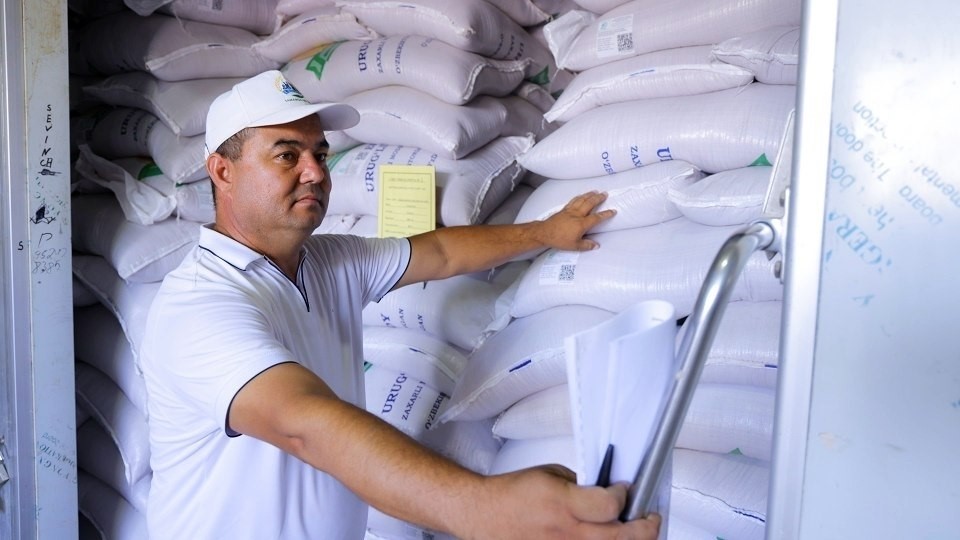
The practice tested in Uzbekistan involves storing dry seed under
controlled cold conditions for up to two months. The approach began as a pilot
in 2025. It was then formally regulated through the Ministry of Agriculture
Order No. 35 of August 7, 2025, registered by the Ministry of Justice as No.
3675.
The legal document uses the operational term “vernalization”; from here
on, I will refer to it simply as the program. But this is not the classic
treatment in which moistened seed is held in the cold. The program uses
prepared, treated, and packaged dry seed stored in refrigerated facilities
under controlled moisture. The package specifies seed moisture of no more than
14%, storage at +1 to +5°C for 45 to 60 days, and documented quality control. Cold
here is a controlled condition used to manage the seed’s pre-plant state and
dormancy. The program is not temperature alone. It is an integrated package of
seed preparation, treatment, moisture control, packaging, refrigerated storage,
and quality checks. Our scientific analysis evaluates the field performance of
that full package.
From 973
hectares to 685,000
In 2025, the program was tested on just 973 hectares. One year later,
for the 2026 harvest, it had expanded to 685,065 hectares. That is 72.3% of
Uzbekistan’s irrigated wheat area. Moving in one season from a 0.1% pilot to
more than 72% is an unusually rapid agricultural scale-up.
Of course, expanding acreage is not a result by itself. Almost any
technology can be rolled out quickly, but for a farmer what matters is its
performance. So our new study did not stop at asking how many hectares were
covered. Within the same harvest year, we directly compared program seed with
traditionally stored seed for the same named variety, variety class, and region.
In 2026, we identified 92 exactly matched variety-by-region pairs
across ten regions. Together they represented 65.2% of the national program
area. Most importantly, in all 92 comparisons, the positive difference in
program fields was clearly visible relative to traditional fields. Let us look
at the results more closely.
In plain terms, when the same variety was compared within the same
region, program fields produced nearly one additional metric ton of grain per
hectare. Program adoption in 2026 ranged from 45.6% to 100% across regions.
Andijan, Bukhara, and Khorezm had fully converted recorded wheat area, while other
regions still grew traditional and program seed side by side. Those
mixed-adoption regions gave us the opportunity for direct comparison.
The
fairest comparison: compare a variety with itself
Large national datasets always carry a risk. A strong variety may be
planted in one region and another variety somewhere else; water and soils
differ, and it then becomes easy to compare the numbers and credit the
technology for differences that may have another cause. That is why, in 2026,
we separately analyzed cases in which the same wheat variety, variety class,
and region included both program seed and traditionally stored seed. We found
92 such exact matches across ten regions. Those pairs represented 446,746
hectares of program wheat, or 65.2% of the national program area.
The result was very clear: in all 92 pairs we observed positive
statistical differences on fields where the program was used. The simple
average difference was 0.90 metric tons per hectare, and the
program-area-weighted difference was 0.94 metric tons per hectare. The positive
direction remained when we applied different statistical checks and when we
recalculated the estimate after removing regions one at a time.
The
difference began at emergence, not at harvest
Even more interesting for us was whether the difference was already
appearing as the wheat emerged. To find out, in 2026 we organized separate
monitoring across 154 districts, 35,875 farms, and 947,110 hectares. In 106
districts, we used both program and traditional seed, allowing direct paired
comparisons.
The positive result became visible from the beginning of the crop’s
life. Program fields reached the 75% emergence threshold an average of 2.59
days earlier. Early stand density was 39.1% higher. That large early difference
naturally narrowed as wheat partially compensated through tillering. Even so,
the number of productive stems remained 9.6% higher at the later stage.
We also observed that crop development moved forward. Tillering
occurred an average of 3.68 days earlier, jointing 3.24 days earlier, heading
3.10 days earlier, and full maturity 3.64 days earlier. Of the 106 paired
districts, 104 reached full maturity earlier, one matured on the same day, and
one matured later.
Some may ask, what difference can three days make? In a region facing
rising heat and water scarcity, three or four days can become extremely
valuable agronomic time. Earlier emergence can give plants more time to
establish roots. Earlier heading and maturity can create an additional window
to avoid late-spring and early-summer heat, save water, and better coordinate
harvest.
The wider wheat
farming ecosystem in Uzbekistan was changing too
One more point should be stated clearly: over the past eleven years,
Uzbekistan’s wheat sector has grown alongside changes in variety turnover, crop
management, water management, seed systems, financing, market mechanisms, and
farmer knowledge.
In 2016, irrigated wheat occupied more than 1.132 million hectares. By
2026, that area had fallen to about 947,000 hectares, a 16.4% decline. Over the
same period, the area-weighted average yield rose from 5.64 to 9.78 metric tons
per hectare, a 73.4% increase. Despite less land under irrigated wheat,
calculated production rose from 6.39 million to 9.26 million metric tons, a 45%
increase. In other words, when genetics, agronomy, water, seed systems,
markets, and farmer decisions work together, a country can produce more from less
acreage.
What does
epigenetically informed farming mean?
When people hear the word “epigenetics,” many picture a laboratory, DNA
methylation, or complex molecular analysis. That is part of the story, but the
farming logic is broader. Seeds with the same genome can still be in different
physiological states. Seed moisture, temperature, storage duration,
physiological age, and later environment can change germination speed and the
course of development. The scientific literature shows that seed dormancy and
germination are linked to hormones, metabolism, and epigenetic regulation.
By “epigenetically informed farming,” we mean understanding a plant’s
physiological and regulatory state without changing its DNA, then translating
that knowledge into agronomic decisions. Cold conditioning of dry seed is one
practical example that grew from this way of thinking. For science, the
positive results observed in this practice now create the next task: uncovering
the biological mechanisms behind them.
Why did
the technology scale so quickly in one year?
A good agricultural idea is not enough on its own. If it never reaches
the farmer, if logistics fail, if storage is unavailable, or if credit and
market incentives are misaligned, a promising technology will remain in the
laboratory or on a pilot farm.
The jump from 973 to 685,000 hectares in one year cannot be explained
by seed physiology alone. Cold-storage infrastructure, seed preparation and
quality control, regional agronomists and extension, farmer participation, market-based
wheat sales, preferential credit, agricultural risk insurance, support for
water-saving technologies, and digital harvest monitoring all reinforced one
another. Biological knowledge becomes useful to farmers only when it is
translated into a practical delivery system.
Can this
experience be transferred to another country?
Absolutely, and it should be. Across Central Asia, South Asia, the
Middle East, and many parts of Africa, farmers work with heat, water scarcity,
short agronomic windows, uneven seed quality, and financial constraints. They
do not always need the most expensive technology. Sometimes a large gain can
come from adapting existing biological knowledge intelligently to local
resources.
But it would be a mistake to take Uzbekistan’s exact 45-to-60-day,
+1-to-+5°C regime and copy it unchanged elsewhere. Other countries have
different varieties, climates, seed moisture, storage infrastructure, planting
calendars, and farmer resources. What is transferable is not the number, but
the logic. To apply that logic properly, a country first needs to understand
the biology of its local varieties and its local problems. It should then
develop a simple, affordable technical solution; test it in a small pilot; show
farmers the results and earn their trust; define quality standards; and support
implementation with infrastructure and finance. Only then should the practice
be scaled broadly.
A country with cold-storage capacity may find that a different regimen
works. Where cold infrastructure is limited, another way of managing seed
physiology may be more practical. The central principle is to adapt epigenetic
and physiological knowledge to the local farming ecosystem.
What does
this mean for a farmer?
A farmer does not walk into the field carrying statistical formulas and
scientific tables. What matters is whether the seed emerges quickly and evenly,
whether the field establishes a healthy and uniform stand, whether the crop
develops on time, matures before damaging heat or unfavorable weather, and how
much grain ultimately reaches the bin.
In the 2026 data, the program showed positive signals at several links
in that chain: earlier emergence, a denser early stand, earlier tillering and
heading, earlier full maturity, more productive stems, and a program-associated
yield difference of nearly 0.9 metric tons per hectare in same-variety,
same-region comparisons. Farmers saw the result with their own eyes and gained
confidence in it. That was a major achievement. These numbers should not be
read as a guarantee for every field, but as results observed in Uzbekistan’s
real 2026 farming system. Every farmer has different soil, water, varieties,
and management. But that is also the strength of the large dataset we collected
and analyzed: the pattern did not come from one research station. We observed
it across diverse conditions where tens of thousands of farmers work.
A new way
to think about food security
Wheat is not just another crop. It is bread, food security, and
national stability. Innovation in wheat therefore cannot be judged only by tons
per hectare. We also need to use water, land, seed, time, and farmers’ capital
more efficiently.
Uzbekistan’s 2016–2026 trajectory shows that total grain production
increased even as irrigated wheat area declined. That matters. It is not
agricultural expansion; it is movement toward smarter intensification.
Epigenetically informed farming should be understood as one part of that larger
system. It does not replace new varieties, water-saving technologies,
fertilizer, or sound agronomic discipline. Instead, it helps align those pieces
from the start, beginning with the seed.
The next era of agriculture may not be defined only by a new gene or a
new variety. A plant cannot walk, but it can “read” its environment: temperature,
moisture, light, and storage conditions send signals that shape its
development. The new era comes from understanding that internal state,
measuring what happens in farmers’ fields, and connecting biological knowledge
with management decisions. Our ancestors did not say this without reason: the
real secret of farming is to “talk with the crop in the field.” In the age of
pangenomics, that deeply human insight takes on even greater meaning.
The 2027
harvest starts this fall: the next layer of agronomic “software”
The
practical question for farmers now is simple: after this year’s results, what
comes next? The fall wheat planting season for the 2027 harvest is approaching.
Depending on the region, planting runs from September into November. The 2026
experience showed how much the condition of the seed before planting can
matter. The next step is to carry that knowledge through the whole production
system. Well-cold-conditioned
(vernalized), high-quality seed needs to
go into the field at the right time, at the right density, and then be managed
as part of one connected agronomic program throughout the season.
One of the
most important new elements in the practical guidance is what I would call
plant-density “software.” On open irrigated fields, the guidance recommends
450–500 kg of high-quality certified seed per hectare when modern grain drills
are used, while planting between cotton rows calls for about 450–550 kg/ha. But the goal is not simply to increase seed kilograms. The real
target is a uniform stand and roughly 8.5–9 million healthy, productive stems
per hectare. In our 2026 field observations, some fields that combined higher
seeding rates with strong agronomic management reached yields of around 10
metric tons per hectare. That is not guaranteed in every field. It shows the
potential of a density-management approach that must be adjusted to variety, germination,
soil, planting date, water availability, and field management.
A second
layer is more precise nutrition and stress-management “software.” Along with
balanced NPK, use additional tools such as boron and other micronutrients,
silicon-based inputs, acetylsalicylic acid, and yeast-based biological
approaches according to the crop’s actual condition and growth stage. In
high-yield, dense fields with a real lodging risk, ethephon may also have a
role, but only as a ready-to-use product registered for wheat, applied
according to the label and at the correct growth stage. None of these inputs is
a “miracle” treatment, and applying the same package to every field would be
the wrong approach.
Our
message to farmers this fall is therefore straightforward: do not let the
seed’s “upbringing” stop when the seed reaches the field. Treat all of the
rules in the practical guide as one connected production chain. Measure stand
density, manage water and nutrition according to crop condition, test each new
practice first on a small comparison strip, and record the result in a field
log. If a good variety is the genetic “hardware,” then this disciplined,
measurable agronomy is the new “software” that can help unlock the 2027
harvest.
Conclusion:
a new era for agriculture in Uzbekistan
In our new
preprint on Research Square, we combined eleven years of national wheat data,
exactly matched variety-by-region comparisons from 2026, and field monitoring
across 154 districts. Our analysis showed the yield difference associated with
the vernalization program, while field monitoring showed how that difference
developed across the crop’s life cycle.
The most
important lesson was seeing a 973-hectare pilot expand to more than 685,000
hectares in a single year and understanding what can happen when science and
implementation come together. All 92 same-variety, same-region comparisons were
positive, and emergence and crop development moved in nearly the same direction
across 106 paired districts. That turns the result into real agronomic
knowledge worth studying seriously. It is already encouraging our scientists to
investigate these positive agronomic signals more deeply at the DNA level. At
the same time, it has already become clear that fundamental biological
knowledge can be adapted to farm practice, its results measured at national
scale, and that this approach is beginning to deliver practical value.
That is
how we see the future of epigenetically informed farming: bringing laboratory
knowledge into farmers’ fields, understanding plant life more deeply from the
seed onward, and using the right agronomic “software” to unlock more of the
potential already present in the genetic “hardware.” One important starting
point for the new era is how we properly “raise” and prepare the seed.
Ibrokhim Abdurakhmonov,
Minister of Agriculture of the Republic of Uzbekistan, Academician
Source: https://www.researchsquare.com/article/rs-10823700/v1