
In New Uzbekistan, at the center of the reforms being carried out under the leadership of President Shavkat Mirziyoyev stands human dignity. By human dignity, we first of all mean creating conditions in which every person’s ability, labor and opportunity can be fully realized. One of the most important dimensions of this principle is raising the dignity of women, ensuring their rights and legitimate interests and expanding their economic, social and political activity.
A strong legal and political foundation has been created in our country in this regard. The Strategy for Achieving Gender Equality in the Republic of Uzbekistan until 2030, as well as Presidential Decree No. PF-87 of March 7, 2022, “On measures to further accelerate work on the systematic support of families and women,” elevated the support of women and the promotion of gender equality to the level of state policy. On this basis, special attention is being paid in ministries, agencies, regions, education and production systems to expanding women’s participation, preparing them for leadership, and supporting employment, entrepreneurship, education and social protection.
In recent years, our country has carried out tremendous work to ensure women’s active participation in public life and to strengthen their role in Parliament, local councils, ministries, agencies, education, science, entrepreneurship and production. This process has become one of the important signs of the development of New Uzbekistan. True development is measured not only by infrastructure, factories, exports or digital technologies, but also by how fully human potential is opened.
In this sense, the agricultural sector could not remain outside these nationwide reforms. On the contrary, the agrarian sector must be at the forefront of this direction. Women’s labor, knowledge, responsibility and life experience are of exceptional importance in tasks such as providing the population with food, raising family incomes, protecting land and water resources, adapting to climate change, creating employment, strengthening processing and developing export chains.
The full development of the agrarian sector cannot be imagined without women's participation.
A woman is not only the keeper of the family. In the agrarian sector, she can be – and already is – a farmer, Dehkan (small landholders), agronomist, veterinarian, breeder, biotechnologist, entrepreneur, scientist, teacher, student, ministry employee, laboratory specialist, food technologist, worker in a processing enterprise and a responsible participant in storage, logistics, trade and export chains. A woman has an important place in every sphere, from the family to education, science, production, business, entrepreneurship and leadership. Wherever she is, she contributes to thrift, product quality, discipline, accounting, a culture of work and responsibility.
Therefore, speaking about gender equality in the agrarian sector is not only about women living in rural areas. It is to speak about the entire agri-food system: the field, farm, household plot, research institute, university, laboratory, warehouse, processing enterprise, market, export, ministry and decision-making process as one integrated system.
In the past, gender equality was sometimes misunderstood. It seemed to set men and women against each other. In fact, its meaning is very simple: let the labor of those who work be seen; let capable people be given opportunity; let the path be opened for those who wish to learn; and let there be no artificial barriers before those who are capable of becoming farmers, agronomists, veterinarians, entrepreneurs, scientists, engineers, technologists or leaders.
Simply put, gender equality is not about weakening the family, but strengthening it. It is not about pushing men aside, but about fully harnessing women’s potential for the country's development. It is not competition, but cooperation. It is not a privilege, but justice.
Why is this issue important for the Ministry of Agriculture?
The answer is simple and logical: agriculture is not only land, water, seed, machinery and fertilizer. Agriculture is a sector of people. Behind every hectare stands human labor; behind every ton of produce stands a family’s income; behind every technology stands knowledge and trust; behind every export contract stands a labor chain; and behind every processed product stand quality and responsibility. Proceeding from the principle of human dignity defined by the President, if we want to turn the agrarian sector into a modern, smart, competitive and humane sector, we must see women’s participation not as a marginal issue but as a central direction of reform.
Let us now turn to another very delicate and vital aspect of the issue: women and food security.
A woman often sees food not merely as a product, but as the family table, a child’s health, household abundance and a blessing that must not be wasted. A mother’s love is a beautiful quality bestowed by the Creator. A mother does not distinguish between children. Even when there is little food on the table, she tries to make enough for everyone. That a child should not remain hungry, an older adult should not be neglected, a guest should not feel unwelcome, surplus food should not be wasted, and there should be reserves for winter – this is not only household experience; it is a culture of food.
This quality should not be viewed merely as an ordinary habit of the home. In fact, it contains a major lesson for agrarian policy.
First is fair distribution. Food security is not only about producing a large volume of food. It is also about to whom, how, how much and in what way that food reaches people. When women’s experiences in the family, community, school, kindergarten, mahalla, market and production systems are included in decision-making, programs are measured not only by tons and hectares but also by human needs.
Second is reducing waste. Women often preserve, in the family and at work, a culture of valuing, processing, storing, saving and not wasting food. Reducing food loss and waste is one of the most important tasks of global agriculture today. If the product grown in the field does not reach the table, then water, land, labor, fertilizer, energy and time have also been wasted.
Third is food quality, together with food security. A mother does not give her child bad food. She tries to remove from the table food that is poor-quality, spoiled, harmful or unsafe. This is not simply a household custom; it is a natural foundation of a food-safety culture. That is why strengthening women’s participation in quality control, sanitation, storage, processing, packaging and market access in agriculture is so important.
Fourth is thinking about the future generation. In many cases, a woman does not look at land, water, food and health only from the point of view of today’s benefit. She thinks about the child, the family and tomorrow. Agrarian policy also needs decisions that are just as far-sighted, close to life and sustainable.
Of course, this does not mean that these qualities belong only to women and are absent in men. Agrarian development is built through the cooperation of men and women. But life shows that women’s experience in family, children, food, thrift, care and community stability makes agricultural decisions more practical, humane and long-term. Therefore, the more women participate in politics, governance, farming, science, education, enterprises and agribusiness, the more complete, just and sustainable decisions become.
The new strategy – a mirror and a practical answer
That is why the Ministry of Agriculture, in close cooperation with the Food and Agriculture Organization of the United Nations (FAO), took an important step: the Gender Equality Strategy in Agriculture for 2025–2030 was adopted (See: https://www.fao.org/europe/news/detail/fao-releases-updated-gender-profile-to-guide-inclusive-agricultural-and-rural-development-in-uzbekistan/en).
This strategy is not an ordinary document. It is the practical expression in the agrarian sector of the policy of human dignity, women’s support, social justice and sustainable development defined by the President. It is a new culture of governance aimed at ensuring equal rights and opportunities for women and men. It is an approach that sees gender not as a “separate social topic,” but as a strategic task linked to the effectiveness, competitiveness, food security and humane development of the agrarian sector.
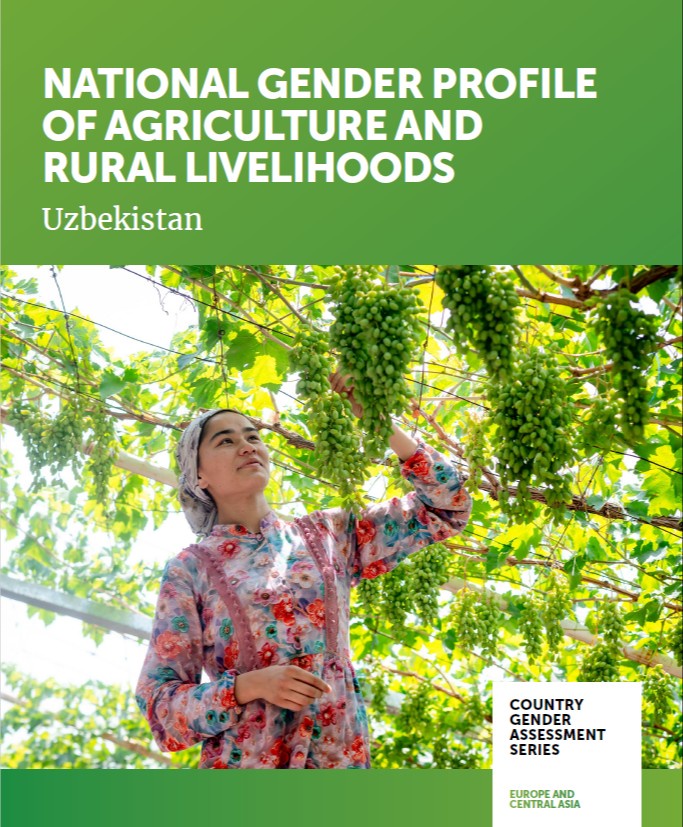
The national gender profile, prepared in collaboration with FAO, became an important scientific and practical foundation for this process. For us, this publication is not just an international report. It is a mirror. It encourages us to look at the agrarian system from another angle: What resources do women have? How visible is their labor? How do they access land, water, finance, agricultural advisory services, education, technology, scientific research, processing, markets and leadership? Is their voice heard in decision-making?
A mirror does not blame a person. It shows reality. If there is dust on the face, the mirror is not at fault. It simply says, “Pay attention here.” FAO’s national gender profile does the same: it shows both the strengths of the agrarian sector and the issues still awaiting solutions. Most importantly, we must not stop at looking into the mirror. After diagnosis there must be treatment; after data, policy; after strategy, action.
The Ministry of Agriculture’s gender strategy is precisely that practical answer.
What does the strategy envisage?
First, it aims to ensure equal rights and opportunities for women and men in the agricultural sector. This means that every person working in the sector, regardless of gender, should have fair access to knowledge, resources, professional development, leadership, entrepreneurship and scientific-practical opportunities.
Second, the strategy aims to expand women’s participation in decision-making processes. When women’s voices are absent from the decision-making table, life experience related to family needs, child nutrition, food waste, local markets, household plots, small livestock, home-based processing, warehousing, storage and food quality is not always fully reflected.
Third, the strategy advances the issue of equal access to resources. Women, too, must be able to fully benefit from access to land, water, finance, credit, subsidies, agricultural advisory services, seed, technology, digital platforms, processing and markets.
Fourth, the strategy sets an important goal: to bring the share of women in positions across the sector to 30 percent. This number did not appear on its own. It arises from the need to expand women’s participation in governance, strengthen their voice in decision-making and prepare a new generation of women specialists in scientific and educational institutions, research institutes, regional systems and agricultural administration.
Fifth, the strategy includes areas such as gender-sensitive budgeting, mentorship programs for women, improving gender statistics, women’s cooperation, training, public events and the broad promotion of a positive image of women in the agri-food system.
It is especially important to note that, in connection with the adoption of the strategy, a high-level National Dialogue was held in Tashkent on “Gender Equality in Agriculture – the Basis of Sustainable Rural Development.” It brought together representatives of government bodies, international organizations, academic circles, non-governmental organizations, women farmers, entrepreneurs and representatives of the agrarian sector. The significance of this dialogue is that gender became not a document kept in an office, but an open field of reform where the public, international partners, scientists and practitioners discuss it together.
To implement the strategy, memoranda of cooperation were signed with FAO, the Committee for Family and Women, the United Nations Population Fund and other partners. A practical action plan for 2026–2030 is being developed. Advisory councils to ensure equal rights and opportunities for women and men have been established within the Ministry’s central apparatus, system organizations, research institutes and higher education institutions.
This is not only about holding events. It is about building institutions. The fate of any reform depends on whether it has an institutional foundation. If gender equality remains a one-day meeting, it will quickly be forgotten. If it turns into a strategy, an action plan, advisory councils, statistics, professional development, budgeting and leadership responsibility, it enters real life.
The strategy is not staying on paper: practical steps have begun
In 2025, in line with the strategy, several practical steps were taken within the Ministry system. Advisory councils to ensure equal rights and opportunities for women and men were established within the Ministry’s central apparatus, system organizations, research institutes and higher education institutions. With FAO participation, a National Dialogue was held on “Gender Equality in Agriculture – the Basis of Sustainable Rural Development.” During the event, memoranda of cooperation were signed between the Ministry, FAO, the Committee for Family and Women, and the United Nations Population Fund.
On the occasion of the International Day of Rural Women, roundtable discussions were held on “The role of women scientists in the development of the agrarian sector,” as well as “three generations” meetings. Active women, women farmers and women scientists who have worked productively in the sector for many years were recognized. Training courses, seminars and practical sessions were held to involve women in farming, household plots and agribusiness widely and to improve their professional knowledge and practical skills.
These efforts did not appear in a single day. In 2024, training seminars were also organized to improve the qualifications of women and men employed in the agrarian sector. Sector employees and farm heads participated in them. Every seminar, every dialogue, and every training is, in fact, a small but necessary step toward major change.
The figures in the Ministry system also give us two conclusions. On the one hand, women are actively working in the sector, studying, improving their qualifications and entering farming. On the other hand, their participation in management and leadership needs to be expanded further. Today, more than 22 thousand employees work in the Ministry system, of whom more than 1.5 thousand are women. Women are present in the central apparatus and in the management system, but increasing their share remains an important task ahead.
For this reason, one of the main goals within the strategy is to increase the share of women in positions across the sector to 30 percent. This is not dry statistics. It means the emergence of a new perspective, new experience and new responsibility in agricultural governance. The increase in women leaders is not only a question of positions. It also means strengthening the perspective of the family, the village, education, health and humaneness in decision-making.
There are also practical results. During 2022–2025, 12.1 thousand hectares of land were allocated to 27.1 thousand women included in the “Women’s Register.” Today, out of 91,712 farms in the republic, 3,145 are managed by women and girls. During 2025, preferential loans totaling 1 trillion 556 billion sums and subsidies totaling 21.8 billion sums were allocated to these women-led farms.
Behind these figures stands the fate of an ordinary person. For a woman who receives land, it is not only hectares – it is trust. For a woman who receives a loan, it is not only money – it is opportunity. For a woman who receives a subsidy, it is not only support – it is a path to expand her own work. For a woman who manages a farm, it is not only a position – it is a source of confidence for other girls in the village: “I can do it too.”
In this sense, the recognition of the Ministry of Agriculture at the national level as a “gender champion” is not accidental. Behind this recognition stand a practical response to the political will defined by the President, international cooperation, strategy, systematic work, support for women and the effort to form a new culture of governance in the agrarian sector. But the greatest meaning of any award is further responsibility. To be a champion is not to reach the finish line. To be a champion is to show the way, deepen results and demonstrate them in the life of every region, every institution, every farm, every enterprise and every woman.
What tasks lie ahead?
Today, global agriculture is entering a new stage. Water scarcity is intensifying. The climate is changing. Soil pressure is increasing. Markets are becoming more demanding. Food security is becoming a strategic issue for every country. Under such conditions, agriculture must be strengthened not only by machinery and investment but also by human capital.
By human capital, we mean not only diploma-holding specialists, but also a knowledgeable Dehkan, a responsible farmer, an advanced agronomist, a woman entrepreneur, a girl aspiring to science, a young specialist who understands digital technologies, a food technologist, a logistics specialist, an entrepreneur who understands the market and a woman whose voice is heard in the community.
Today, we speak a great deal about smart agriculture. Drones monitor fields. Sensors measure soil moisture. Digital platforms provide information to farmers. Water-saving technologies protect resources. Biotechnology, seed systems and genomics increase yields. But true smart agriculture is not made of technology alone. It must be a system that also sees the human being.
If a drone detects disease in the field but the management system does not see the invisible labor of women, it is not yet a fully smart system. If a sensor measures soil moisture but policy does not measure women’s access to resources, it is not yet fully just governance. If export figures grow while women remain only cheap labor in the value chain, it is not yet fully humane development.
Now the following important tasks stand before us:
First, the gender strategy must be explained clearly in every region. This document must not remain only in ministry offices or in materials of international conferences. Its meaning must be understood at the levels of regions, districts, farms, agrarian universities, colleges, mahallas, cooperatives, enterprises, warehouses and processing and trade systems.
Second, gender statistics must be strengthened. How many women have studied? How many women received credit? How many women are engaged in farming? How many women have risen to leadership? How many women are active in processing, logistics, exports and agribusiness? In which regions are the barriers greater? Which program has delivered real results? Without clear answers to these questions, policy also moves blindly.
Third, knowledge and finance for women must go hand in hand. Training alone is not enough without access to funds. Credit alone is also not enough without agronomic, legal, accounting, digital and market knowledge. Finance without knowledge is risky; knowledge without finance is ineffective. When the two go together, entrepreneurship grows.
Fourth, a system is needed to prepare women for leadership. Leadership does not appear by chance. Mentorship, professional development, practice, public speaking, digital skills, legal literacy and project management are all necessary for the growth of women specialists.
Fifth, gender equality must enter all new areas of agriculture: digital agro-platforms, water-saving technologies, climate adaptation programs, food security, cooperation, seed systems, veterinary science, agribusiness, exports, processing and scientific research.
So there is much work to be done. It will not be easy. But our path is right.
What will the agriculture of Uzbekistan’s future look like?
There, drones will fly over fields, but human dignity will not be forgotten. There, water-saving technology will work, but the needs of the family and society will be taken into account. There, genomics and biotechnology will develop, but ordinary farmers will receive advice in a language they understand. There, exports will grow, but women’s labor will not remain cheap and invisible. There, the market will be active, but it will not stand above the human being.
Today, agriculture needs a new way of seeing. Land is not only a resource, but a source of life. Water is not only a means of production, but a trust from generations. Science is not only an article or a patent, but a service to people’s lives. A woman is not only a helper, but a full participant in development.
That is why FAO’s national gender profile held up a mirror to us. The Ministry of Agriculture’s Gender Strategy for 2025–2030 looked into that mirror and chose a practical path. Now, the most important task is to implement this strategy deeply in life. We must not forget that behind every number stands a human being, behind every program stands a family, and behind every opportunity stands a future generation.
The true measure of reform is not that a document has been adopted, but what change it creates in human life. The greatest purpose of the gender strategy is exactly this: to see women, hear them, support them and turn them into equal builders of Uzbekistan’s agrarian development. Where women’s dignity is seen in the field, abundance grows; where women’s voices are heard in the sector, justice grows. The agriculture of New Uzbekistan must be exactly this: modern, smart, competitive, science-based, open to the market, but above all, a sector that places human dignity at a high level.
Ibrokhim Abdurakhmonov,
Minister of Agriculture of the Republic of Uzbekistan, Academician