
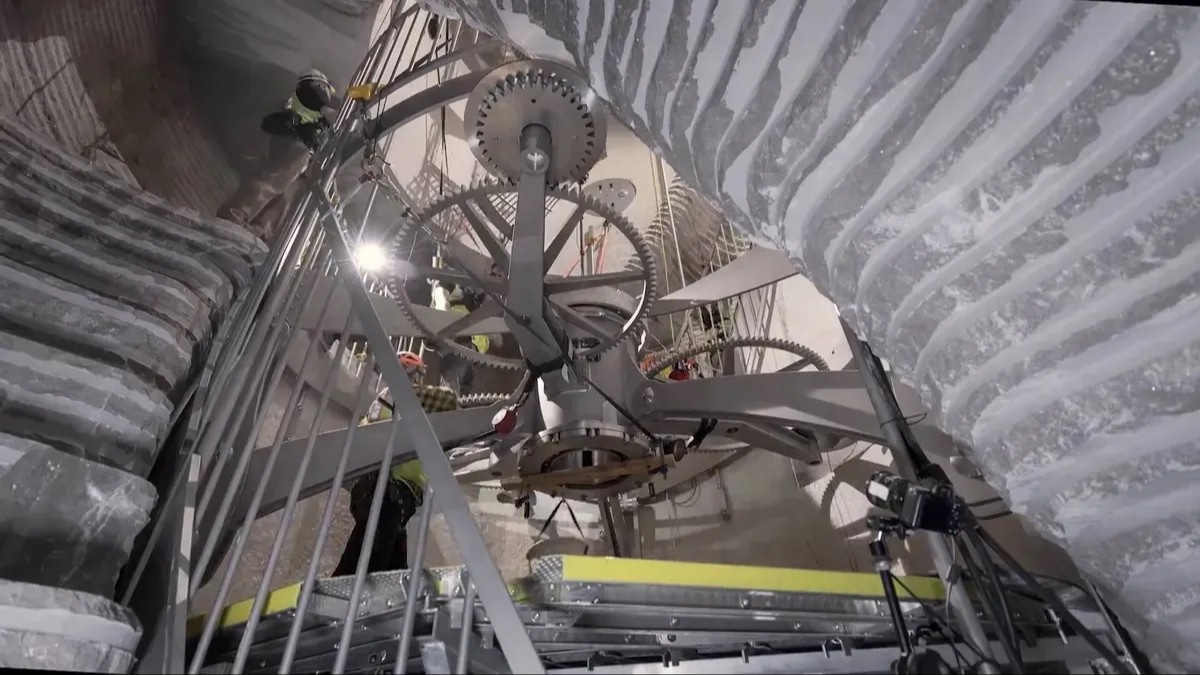


Deep inside the mountains in Texas USA, the work on the "10,000-year clock", or Clock of the Long Now, is underway. Owned by the founder and executive chairman of Amazon, Jeff Bezos, the mechanical clock is taking $42 million to build and will tick once a year for the next 10,000 years.
A two-metre prototype of the clock is on display at the Science Museum in London, and the Long Now Foundation is building the clock. The clock is the brainchild of Danny Hillis, who conceived it in 1986. The first prototype of the clock began working on December 31, 1999, in time to display the transition to the year 2000. At midnight on New Year's Eve, the date indicator changed from 01999 to 02000, and the chime struck twice.
Bezos Expeditions, owned by Jeff Bezos, is funding the manufacturing and site construction of the full-scale prototype clock for $42 million. The clock is being constructed on land that the billionaire owns in Texas.
What is the purpose of the 10,000-year clock?
A note by Jeff Bezos on the 10,000-year clock website reads: "The father of the clock is Danny Hillis. He's been thinking about and working on the clock since 1989. He wanted to build a clock that ticks once a year, where the century hand advances once every 100 years, and the cuckoo comes out on the millennium. The vision was, and still is, to build a clock that will keep time for the next 10,000 years."
Stewart Brand, a founding board member of the Long Now Foundation, said that the clock would embody deep time for people. "It should be charismatic to visit, interesting to think about, and famous enough to become iconic in the public discourse. Ideally, it would do for thinking about time what the photographs of earth from space have done for thinking about the environment. Such icons reframe the way people think."
What is the design of the 10,000-year clock?
Hillis stated that he plans to build a clock that ticks once a year. "I want the cuckoo to come out every millennium for the next 10,000 years. If I hurry, I should finish the clock in time to see the cuckoo come out for the first time."
The clock is being built on the following design principles:
-Longevity: The clock should be accurate even after 10,000 years
-Maintainability: Future generations should be able to keep the clock working
-Transparency: The clock should be easily understandable without disassembling it
-Evolvability: There should be a provision to improve the clock over time.
-Scalability: To ensure that the final large clock works properly, smaller prototypes must be built and tested.
The official website of the 10,000-year clock states that the mountain in which the clock is housed will have five room-sized anniversary chambers for the one-year, ten-year, 100-year, 1,000-year, and 10,000-year anniversaries of the completion of the clock.
"We aren't planning to build the animations for the 100, 1,000, and 10,000 year anniversary chambers, but will instead leave those to future generations. We are providing a mechanical interface into those chambers that provides those future builders with power and the correct clock triggering events. We do intend to build the animation for the 10 year anniversary chamber, but haven't decided what it will be yet," the website reads.
Where is the 10,000-year clock located?
For the permanent storage of the clock, once it is constructed, the foundation bought the top of Mount Washington in Nevada, surrounded by Great Basin National Park. The clock will be housed in a series of rooms in the white limestone cliffs, approximately 10,000 feet (3,000 m) up the Snake Range. The clock will be almost entirely underground, and only accessed by foot traffic from the east once complete.
The clock will be almost entirely underground, and only accessed by foot traffic from the east once complete
Before building the public clock in Nevada, the foundation is making a full-scale clock of a similar design in a mountain near Van Horn, Texas. The foundation started test drilling for the underground construction at the site in 2009.
The official website of the 10,000-year clock states that visiting the clock will not be easy. "The nearest airport is several hours away by car, and the foot trail to the clock is rugged, rising almost 2,000 feet above the valley floor," the website states. It further states: "Building a clock inside a remote mountain is a big task. The construction is under way, and we're making progress every day. This is the way you'll initially enter the series of tunnels and chambers that we're creating within the mountain."
What is the power source of the 10,000-year clock?
In order to power the clock, methods such as nuclear power and solar power systems were rejected as they would violate the principles of transparency and longevity. Finally, Hillis decided upon regular human winding of a falling weight design for updating the clock face because the clock design already assumes regular human maintenance.
How will the clock display the time and date?
The centre of the clock will have a star field, indicating both the sidereal day (it represents the time taken by the earth to rotate on its axis relative to the stars, and is four minutes shorter than the solar day) and the precession of the zodiac
Around this, there will be a display showing the positions of the sun and the moon, as well as the phase and angle of the moon. Outside this, a double dial with digits will display the year according to the current Gregorian calendar system.
The clock will have a five-digit display, indicating the current year in a format like "02000" instead of the usual "2000".
How will the clock calculate time?
The clock uses binary digital logic implemented mechanically in a sequence of stacked binary adders. The conversion logic involves a digital computer with mechanical wheels and levers instead of typical electronics. The computer has 32 bits of accuracy, with each bit represented by a mechanical lever or pin that can be in one of two positions. This binary logic can only keep track of elapsed time, like a stopwatch. In order to convert from elapsed to local solar time (time of day), a cam subtracts from or adds to the cam slider, which the adders move.