
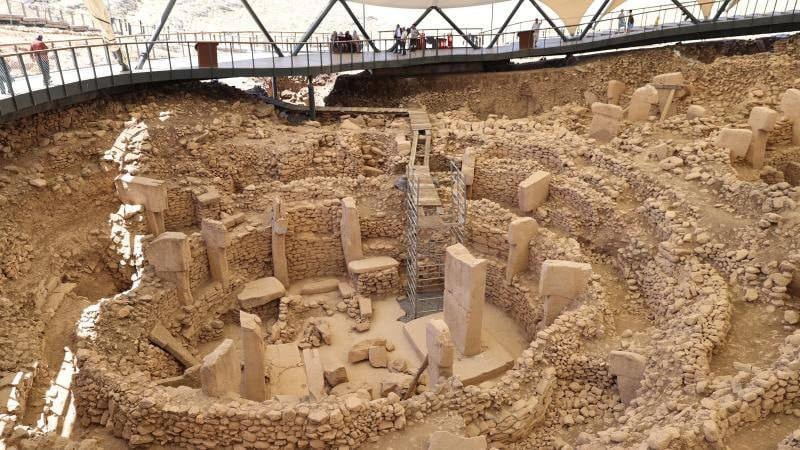
Turkish Minister of Culture and Tourism Mehmet Nuri Ersoy inspected the ongoing excavations at Göbeklitepe, a UNESCO World Heritage Site. He emphasized that the 12,000-year-old Göbeklitepe is the starting point of not only Anatolian but also all of human history, and announced that a new and unique statue had been found during the excavations there.
"I would like to share the good news that another very important discovery has been found during the excavations at Göbeklitepe. In the area between Buildings B and D of Göbeklitepe, a human statue was found that was horizontally placed inside a room wall and is believed to have been placed as a votive offering. We have found similar examples in Karahan Tepe. However, this new discovery from Göbeklitepe is a very valuable find that sheds light on the rituals and belief system of the Neolithic period."

Furthermore, according to Deputy Minister of Culture and Tourism Gökhan Yazgı, the statue's location carries a unique symbolic meaning while also reshaping many perceptions about the Neolithic period.
A Symbol of the Period's Sculptural Achievement
Necmi Karul, the director of the Göbeklitepe excavations, also provided information about the statue, emphasizing that it has no legs, but its head and body are clearly defined. According to him, the fact that the statue was located inside a wall makes it difficult to fully determine its function.
“At Göbeklitepe, one can see the high skill of sculpture in works created with an aesthetic style. There are statues from the Neolithic period, but it is the first time we have observed this statue placed on its back and in a broken state inside a wall. To draw a definite conclusion about why it was placed there will require time,” said Karul, suggesting that the statue may have been part of a ceremony held at that location.
"Interest in Göbeklitepe Continues Steadily"
In his speech, Mehmet Nuri Ersoy emphasized that the excavations started at Göbeklitepe were a turning point in the world of archaeology. He added that they are not only content with the work carried out within the framework of the "Heritage for the Future" project, but are also restoring and protecting the finds and passing them on to future generations.

"In Building C, the largest structure found at Göbeklitepe so far, extensive work from strengthening the walls to returning the upright stones to their original places has been successfully completed. The upright stones, weighing tons and reaching up to 6 meters in height, were once again made upright with the meticulousness and high skill of our scientists. In this process, special attention was paid to ensuring that every material used conformed to the original. Now, we are stepping into a new era not only in excavation and preservation but also in visitor management. We aim to steadily manage the interest in Göbeklitepe through a new visitor center, a parking lot, and pedestrian paths, which will be put into service by the end of 2025. Göbeklitepe is the common heritage of all of human history," said Mehmet Nuri Ersoy.
Throughout 2025, within the framework of the "Stone Hills" project, archaeological excavations were carried out at 10 different sites with a team of 220 specialists and students from 36 international scientific institutions.