
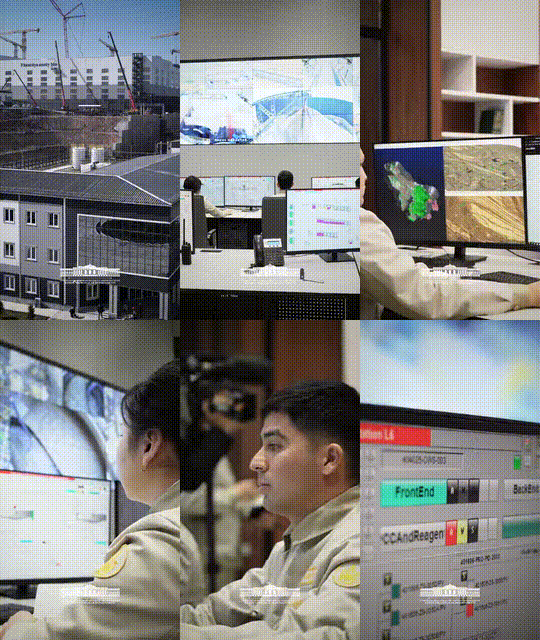
This center plays an important role in coordinating production processes at the first, second, and third copper-processing plants of the complex, thereby increasing efficiency and ensuring continuous monitoring.
With the help of modern digital management systems, large monitoring screens, video surveillance tools, as well as the Siemens PCS 7 and AVEVA PI Vision platforms, processes such as crushing, flotation, thickening, filtration, the supply of reagents and process water, as well as the operation of workshops and the transport system are monitored in real time.
In other words, this center serves as the “brain” of the plant more than 20,000 pieces of equipment are connected to a unified information system. Smart cameras perform primary monitoring, while artificial intelligence automatically detects anomalies. This makes it possible to analyze data and make decisions promptly.
While reviewing the center’s activities, the President highlighted the significant potential of artificial intelligence to increase efficiency, especially in the mining and metallurgical industries. At the same time, special attention was paid to the need to widely introduce modern resource-saving technologies to ensure the rational use of water resources.
Plans for the digitalization of the complex’s production and technological processes were also presented to the Head of State.
As noted, all stages – from ore extraction in the quarry to the production of finished products – are being consistently digitalized. Over the next five years, artificial intelligence-based solutions are planned to be widely introduced at every stage.
Information was also presented on the progress of the digitalization of deposits, based on geological and mine surveying data accumulated over 80 years. In particular, the “Digital Mine” system enables accurate determination of the directions of mining operations for the day, week, and month.
The condition of quarry roads is monitored using artificial intelligence, while sensors track the pressure and temperature of dump-truck tires. Thanks to such continuous monitoring, the service life of the tires has increased by 14 percent.
It was emphasized that one of the priority tasks remains the training of specialists with a deep command of modern technologies, as well as the education of personnel in new working methods and digital solutions.
Particular attention was also paid to expanding patent activity. The need was noted to patent scientific and technological solutions applied at every stage of the plant’s operations, to strengthen cooperation with authorized organizations in this field, and to identify promising areas for innovation.
As emphasized, a new patent means a new technology, a new production direction, and new markets. Considering that the country’s rich raw material base opens broad opportunities for entering global markets, the task has been set to develop clear approaches to determining which promising areas and in what volume new patents can be obtained as early as 2026.