
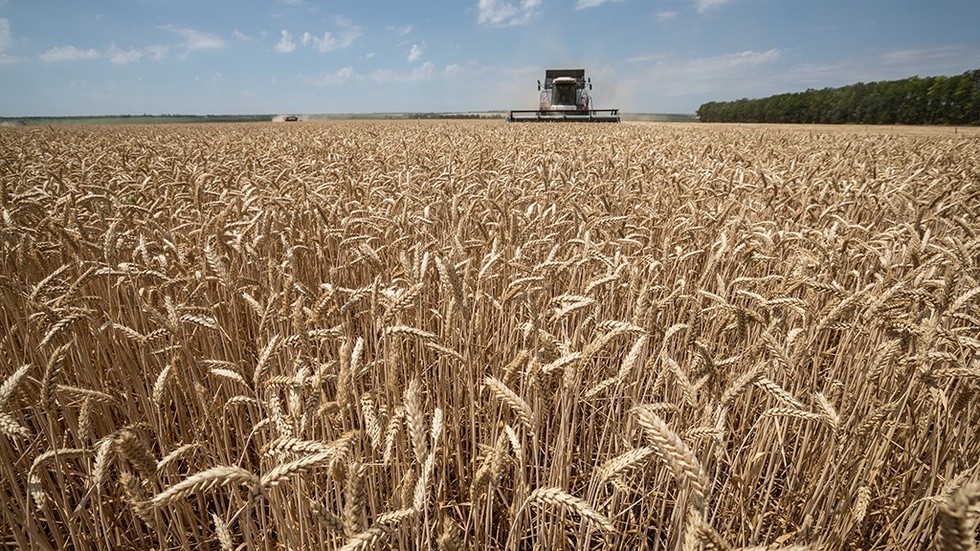
Tashkent – For Uzbekistan, a country with a population of more than 38 million, wheat production remains a central pillar of food security. National agricultural authorities reported that the 2026 wheat season delivered strong yields, reflecting ongoing efforts to strengthen domestic grain supplies, support farmers and improve the productivity of irrigated agriculture.
The average wheat yield reached 9.57 metric tons per hectare, around 1.1–1.5 metric tons per hectare higher than last year’s level. Authorities attributed the result to improved seed quality, renewed varieties, better crop nutrition, more efficient water use, targeted economic support for producers and better-organized harvesting.
The outcome reflects the broader policy direction set under the leadership of President Shavkat Mirziyoyev to modernize agriculture, strengthen food security, support farmers, raise rural incomes and improve the efficiency of land and water use. These priorities are also reflected in Uzbekistan’s Agriculture Development Strategy for 2020–2030, which emphasizes productivity growth, market-oriented support mechanisms, sustainable resource management, mechanization and digitalization.
One key factor was variety renewal. For the 2026 harvest, winter grain crops were cultivated on 947,000 hectares of irrigated land. To increase productivity, older wheat varieties were replaced on 610,000 hectares with 12 new high-yielding varieties, including eight domestic varieties, selected for local soil and climate conditions.
A second factor was timely crop nutrition and field management. During the spring growing period, wheat fields received three applications of nitrogen fertilizer, along with four to five foliar treatments with micronutrient-enriched biostimulants to support yield formation and grain quality.
Economic support for producers also helped reduce production risks. More than USD 400 million in concessional credit was allocated at a 10 percent interest rate to finance the cultivation of 743,000 hectares by more than 25,000 wheat-producing farms. Additional public support included about USD 12 million in electricity subsidies for more than 16,700 farms, as well as about USD 22.1 million in subsidies to introduce water-saving technologies.
Support for water-saving technologies was also expanded in the wheat sector. While subsidy mechanisms had previously supported sprinkler and pivot irrigation systems, in 2026, they were extended for the first time to include drip irrigation in wheat production. Authorities said this step was aimed at helping farmers maintain yields while using scarce water resources more efficiently.
The Government also provided partial compensation for diesel fuel costs from April 1 to July 1, 2026, totaling approximately USD 9 million, allocated from the state budget. Wheat producers who repay their concessional grain loans in full by August 1 are also expected to receive a subsidy covering 4 percentage points of the 10 percent interest payment.
Another notable feature of the season was the broad use of a practical seed-conditioning method described by national specialists as epigenetically informed. The approach was designed to help manage seed dormancy, activate germination and support faster, more uniform crop establishment. Before sowing, about 170,000 metric tons of seed grain were stored for 45–60 days in refrigerated conditions at +1 to +5°C, and conditioned seed was used on 700,000 hectares.
This approach complemented conventional vernalization by focusing on controlled dormancy management and early crop establishment. Crop growth and development advanced by 8–10 days compared with previous years, while uniform emergence was achieved within 10–12 days. Plant density averaged 5.5–6.0 million plants per hectare, contributing significantly to higher yields.
More than 11,000 farmers, representing about 32 percent of wheat producers, achieved yields above 10 metric tons per hectare by applying advanced agronomic practices. The season also showed growing financial capacity among producers: nearly 9,000 farms cultivated wheat on 204,000 hectares, or about 22 percent of the total wheat area, using their own funds without preferential credit.
The 2026 wheat season shows how science-based variety selection, seed dormancy management, improved crop nutrition, water-saving technologies, targeted subsidies, transparent harvest logistics and farmer-oriented market support can contribute to stronger food security and rural livelihoods in Uzbekistan.
Source: National agricultural and farmers’ council data provided for the 2026 wheat harvest season.