
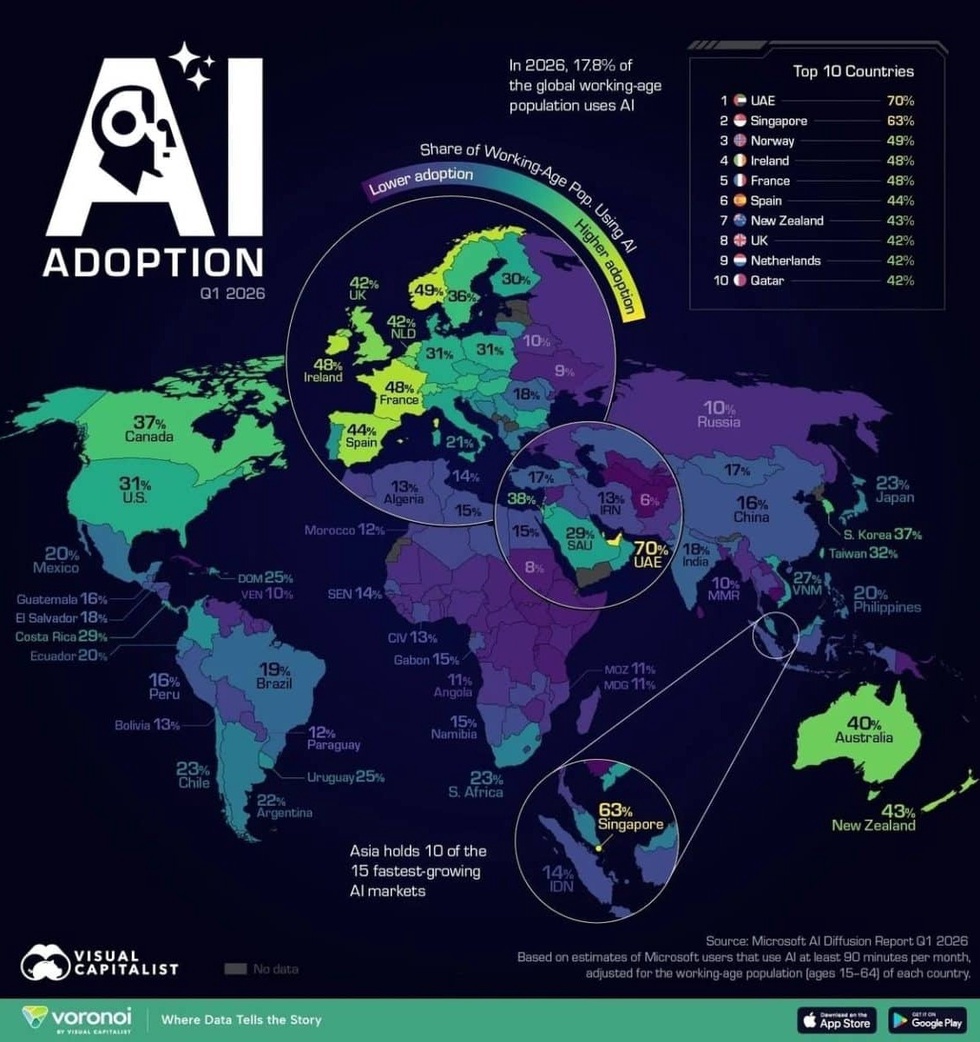
According to Microsoft estimates, in the first quarter of 2026, about 17.8% of the world's working—age population regularly used artificial intelligence-based tools - that is, they spent at least 90 minutes per month with them.
The United Arab Emirates has become the absolute world leader: more than 70% of working-age residents there are already actively using AI. Singapore ranks second with an indicator of 63%. naked-science.ru.
At the same time, the United States, where many leading AI model developers are located, is not even among the top twenty countries in terms of technology adoption. Many European countries turned out to be significantly higher, including Norway, Ireland, France, Spain and the Netherlands, where the level of AI use exceeds 40%. Europe's high performance is explained by the developed digital economy, high-quality Internet and a large number of specialists who are used to working with digital services.
At the same time, many developing countries are still only at the initial stage of implementing AI. This creates a growing global gap that could seriously affect labor productivity and the competitiveness of economies in the coming decade.
Despite leading the world in AI investment, model development, and computing infrastructure manufacturing, the U.S. has a regular AI usage rate of only 31.3%, lower than twenty other countries. Analysts cite the scale of the country as one of the reasons. It is much more difficult to implement AI among a huge and heterogeneous labor market than in compact and centralized digital economies like Singapore or the UAE.
The study also highlights the growing gap between AI creation and its day-to-day applications. America still dominates model development, chip design, and venture financing, but some small states are faster at integrating AI into routine workflows.
According to Microsoft, Asia already includes 10 of the 15 fastest growing artificial intelligence markets in the world. The sharpest growth was recorded in South Korea: from the first half of 2025 to the first quarter of 2026, the use of AI there increased by 43.2%. Thailand (36.2%), Japan (34.1%) and Mongolia (32.2%) are also growing rapidly.
In many ways, this leap is due to a significant improvement in the quality of AI work in non-English languages. Over the past year, AI services have become much more useful for Asian users, and the states of the region are actively investing in digital infrastructure.
Interestingly, China is still showing a relatively low rate of about 16%. However, even moderate growth in a country with such a population can add hundreds of millions of new AI users.
As artificial intelligence penetrates deeper into everyday work, differences in the pace of its adoption may become one of the key factors of economic inequality in the next decade, just as mass digitalization and the spread of the Internet changed global competition.