
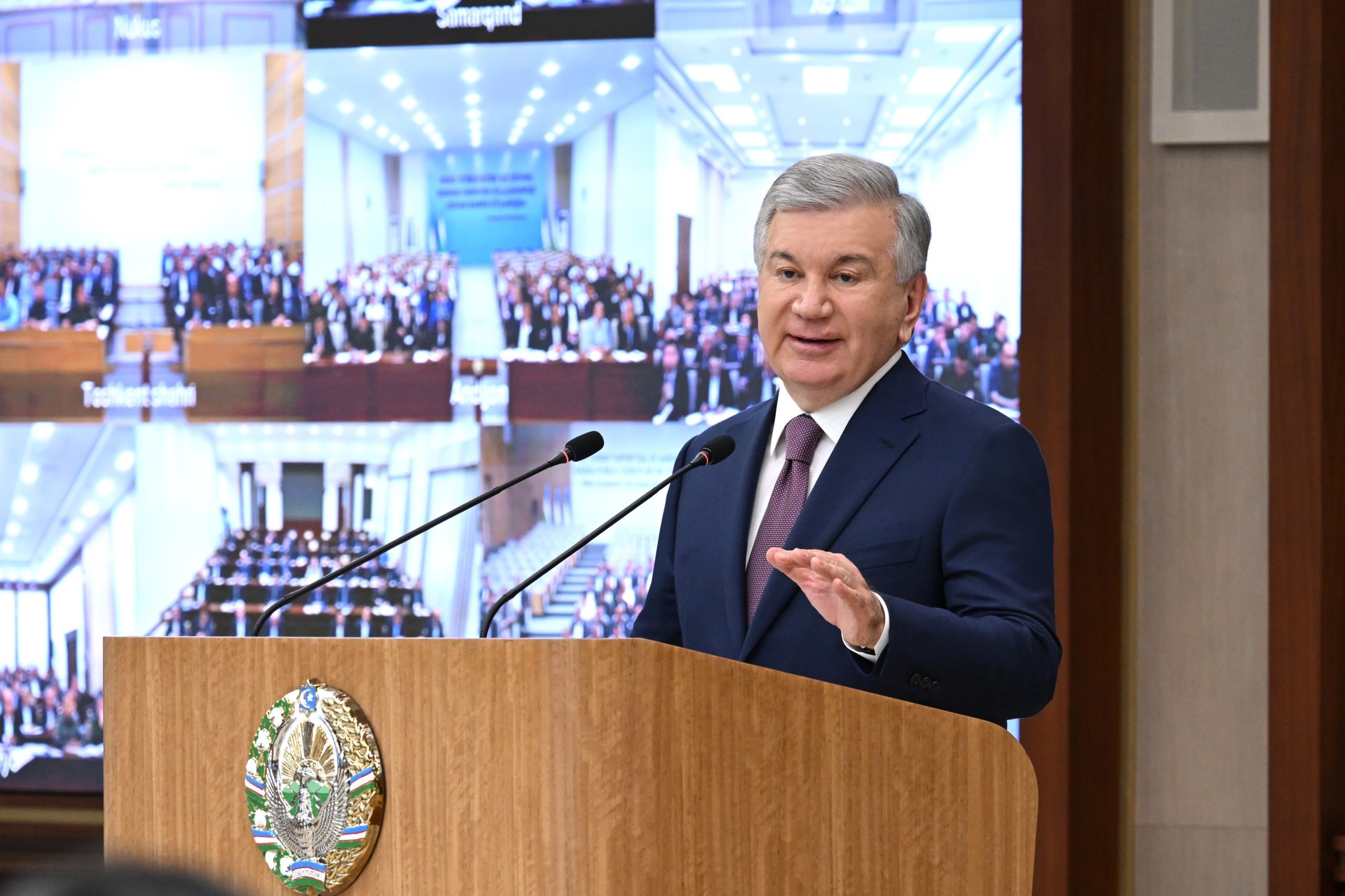
At the
beginning of the meeting, the macroeconomic results for the first quarter of
the current year were reviewed. In particular, gross domestic product grew by
8.7 percent, industry by 8 percent, the service sector by 16.1 percent, and
agriculture by 5.1 percent. Exports totaled $5.8 billion, and foreign
investment reached $13.7 billion. The annual inflation rate fell to 7.1 percent
for the first time.
As a
result, budget revenues for January-March increased by 35 percent compared with
the same period last year, reaching 103 trillion UZS. An additional 2.2
trillion UZS were generated for local budgets. Notably, 1.4 trillion UZS
remained with districts and cities.
The Head of
State emphasized that systemic reforms are underway to elevate the economy to a
new level internationally. In particular, it was noted that next month, for the
first time, 30 percent of state assets, valued at 2.4 billion dollars, will be
listed on international stock markets. This is linked to the establishment of
the National Investment Fund and the transfer of management of 13 strategic
enterprises to the prestigious company Franklin Templeton.
According
to a report published last week by the International Monetary Fund, Uzbekistan
maintains stable, dynamic economic growth driven by high levels of economic
activity. This year, the country also rose 14 positions in the prestigious
Index of Economic Freedom and, for the first time, was ranked among countries
with a “moderately free economy”.
At the same
time, the President stressed that it would be absolutely wrong to become
complacent after the first-quarter results. It was noted that, given escalating
global tensions and intensifying competition for leadership, the global economy
is unlikely to remain as stable as before. Under such circumstances, all
leaders must fundamentally reassess their working methods, approaches, and
mindset.
The meeting
also addressed the development of small and medium-sized businesses. This year,
140 trillion UZS have been channeled to the sector through banks. For example,
for every 1 billion UZS of credit extended to small businesses, 20 permanent
jobs were created in the city of Shirin, 17 in Uchkuduk, 14 each in Khanabad
and Sokh, and 13 in Tamdy district.
However, in
Uchkuprik, Pskent, Bostanlyk, Karmana, and Kurgantepa districts, an average of
only three jobs were created for every 1 billion UZS of credit.
In this
regard, the importance of using artificial intelligence in allocating credit
resources was emphasized. Responsible officials were instructed to begin
training district-level bank employees to work with artificial intelligence and
to launch the AI Advisor platform in banks. It was noted that the platform
should provide entrepreneurs with ready-made solutions for obtaining loans by
analyzing project parameters, associated risks, and market demand.
Issues in
working with entrepreneurs were also criticized. It was noted that some
officials, instead of resolving entrepreneurs’ problems, avoid responsibility
and, when issues reach the national level, offer explanations.
For example,
in the city of Nurafshon, officials, rather than assisting an entrepreneur who
has been unable to begin construction for two years due to bureaucratic
barriers, focused on determining how this information reached the President. It
was also noted that in Guzar, Naryn, Urgench, Yangiyul, and Chinaz districts,
despite the allocation of 262 billion UZS for business infrastructure
development, project implementation has not yet begun. Regional hokims were
instructed to assess the suitability of such officials for their positions.
Particular
attention was also given to curbing inflation. The Head of State stressed that,
despite economic growth, rising inflation will prevent the population and
entrepreneurs from fully experiencing the positive changes in their lives.
Since the
beginning of the year, global oil prices have risen by 40 percent. Geopolitical
tensions have rerouted logistics corridors, leading to a 25-30 percent increase
in transportation costs for both exporting domestic products and importing
essential consumer goods. This has put additional pressure on domestic prices.
At the same
time, it was emphasized that efforts to curb inflation must not be left to
chance amid external pressures. Noting that 70 percent of the consumer basket
consists of domestic goods and services, responsible officials and hokims were
tasked with increasing the supply of domestic products and reducing prices to
keep inflation at 6.5 percent this year.
Food
security issues were also discussed in detail. Due to logistics disruptions,
cattle imports declined by half in the first quarter. As an immediate measure,
steps were introduced to provide up to 4 million UZS in compensation for air
transportation of each breeding animal and to reimburse half of the
transportation costs for meat imports.
It was
noted that in the second quarter, it is necessary to ensure the import of
45,000 tons of meat, bringing the total to 130,000 tons by the end of the year.
Responsible officials were instructed to promptly address emerging issues,
including obstacles and delays across transport corridors, through online
monitoring, without waiting for entrepreneurs’ appeals.
It was also
reported that 478,000 hectares are planned to be sown with fodder crops across
the regions. It was noted with criticism that in Namangan region, sowing has
not yet been completed in 74 percent of fodder areas, and in Zarbdor,
Qiziltepa, and Pap districts, which have high potential for animal husbandry,
silage preparation has not yet begun. Work in Amudarya, Gijduvan, Khanka, and
Baghdad districts was also deemed unsatisfactory.
An
additional 100,000 hectares of agricultural land are planned to be auctioned
under a new system. The need to promptly auction these lands and ensure their
timely sowing was emphasized. Noting that entrepreneurs establishing industrial
plantations receive benefits and financial resources, regional hokims were
instructed to organize at least five large-scale industrial fruit and vegetable
plantations as model projects this year.
The meeting
also critically reviewed developments in industry and exports. It was noted
that Qamashi, Qarshi, Mirishkor, Arnasay, Sharaf Rashidov, Yangiabad,
Navbakhor, Kasansay, Kumkurgan, Furkat, Shavat, Shaykhantakhur, and Sergeli
districts failed to meet their industrial production targets. Disciplinary
measures were ordered against the hokims of these 13 districts based on the
extent of their shortfall relative to the forecast.
Despite an
increase in domestic copper supply, processing capacity does not exceed 6,000
tons per month. As a result, industrial production growth in the electrical
engineering industry in the first quarter was 7.8 percent, against a forecast
of 11.2 percent, while the export target was met at only 57 percent.
Responsible
officials have been instructed to visit every enterprise where production and
export volumes have declined and to promptly address issues with export
financing and investment projects on the ground. The task is to increase the
industry’s production volume to 25 trillion UZS and exports to $1 billion by
the end of the second quarter.
Attention
was also given to improving resource efficiency and labor productivity at
enterprises. It was noted that many countries apply advanced methods such as
Kaizen and lean production in industry and services, and that around 50
entrepreneurs in the country have already begun implementing similar
approaches. It was emphasized that this is insufficient, and the Ministry of
Economy and Finance was instructed to implement efficiency-improvement programs
at 100 enterprises this year and to attract $30 million in grant funding for
this purpose.
Issues in
supporting exporters were also highlighted. Although 908 entrepreneurs have
signed contracts worth $3.6 billion over the past six months, they have been
unable to begin exports due to changes in their relations with foreign
partners. Some hokims, instead of providing support, allowed the situation to
drift.
As a
result, in Naryn, Kasbi, Sherabad, Yazyavan, and Denau districts, exports more
than halved in the first quarter, while in Shakhrisabz, Uchquduq, Parkent, and
Tashkent districts, as well as in the cities of Jizzakh, Navoi, Namangan,
Angren, Bekabad, and Nurafshan, export performance did not reach even 70
percent of the forecast. It was noted that if indicators do not improve by the
end of the first half of the year, strict conclusions will be drawn regarding
the leaders of these regions.
The
effective use of industrial zones was also considered. It was noted critically
that in 226 industrial zones, where road, energy, and water infrastructure have
been developed at the expense of the budget, project implementation has not yet
begun on 213 hectares. At the same time, it was noted that in 27 industrial
zones, despite the presence of planned projects, the necessary infrastructure
has not yet been provided.
Deputy
hokims of the regions responsible for investment were instructed to compile a
portfolio of projects for placement in available areas of industrial zones with
established infrastructure.
The
optimization of the administrative areas of state bodies and the creation of
new spaces for business were also discussed. It was noted that state
institutions occupy a significant portion of central and busy streets in the
districts. Based on the Kukdala experience, the relocation of state bodies to
unified administrative centers has begun in 19 districts and cities.
It was
noted that scaling up these measures across all districts will save 1.8 billion
kilowatt-hours of electricity and 340 million cubic meters of gas annually in
state institutions, while also freeing up 5 million square meters of space for
business. To this end, instructions were given to prepare a five-year program
and to begin relocating state bodies to unified locations in 26 districts this
year. It was set that the average area per employee in new administrative
centers should not exceed 15 square meters.
Special
attention was paid to the quality of investment projects. The Head of State
emphasized that every new project and every dollar invested must create added
value, high-income jobs, and export growth. It was noted that the main
criterion for all leaders should be the quality of investments.
A platform
has been established to monitor investment projects after launch. Through this
platform, it was found that of 688 enterprises that began operations in the
past three years, 210 are not operating at full capacity. As a result, 33
trillion UZS in potential output have been lost, and 23,000 jobs remain vacant.
Responsible
officials have been instructed to develop roadmaps for each of the 210
enterprises, setting clear deadlines to resolve issues and assigning
responsible executors.
This year,
the goal is to attract $53 billion in foreign investment. The President
emphasized that investments will be high-quality only if leaders select the
right projects from the outset and identify investors with the appropriate
capacity.
Responsible
officials have been tasked with implementing a platform that uses artificial
intelligence to analyze existing production capacities and demand in domestic
and foreign markets, and to provide guidance on which projects to implement in
specific regions. Access to this platform will be provided to investors and
consulting companies on a single-window basis.
An analysis
of the activities of foreign-invested enterprises was also conducted. More than
18,000 such entities operate in the country. However, 526 enterprises with
production lines have never exported. Another 767 enterprises with foreign
investment are engaged exclusively in the sale of imported goods.
The need
for a systematic approach to working with such enterprises was emphasized,
including offering them projects to establish local production, fostering
cooperation with domestic entrepreneurs, developing the production of spare
parts and components, and supporting companies operating in the domestic market
in entering export markets. Responsible officials have been instructed to
develop a separate program in this area.
The meeting
also addressed the issue of scaling up the Smart District platform and the
experience of the situational-analytical centers. The day before, the Head of
State reviewed the results of the platform’s implementation at the
situational-analytical center in Mirzo Ulugbek district. On the same day,
hokims from all regions visited the district to become familiar with the
operation of the new system, as well as the condition of mahallas and ongoing
construction.
Based on
this experience, regional hokims have been instructed to launch similar
situational-analytical systems in regional centers and major cities within two
months.
The Head of
State emphasized that leaders at all levels bear personal responsibility for
achieving results amid current challenging conditions. It was noted that
ensuring economic growth, curbing inflation, creating jobs, increasing exports,
improving the quality of investments, and addressing entrepreneurs’ problems
should serve as the main criteria for every leader’s performance.
At the
meeting, reports were presented by ministers, industry heads, and hokims.