
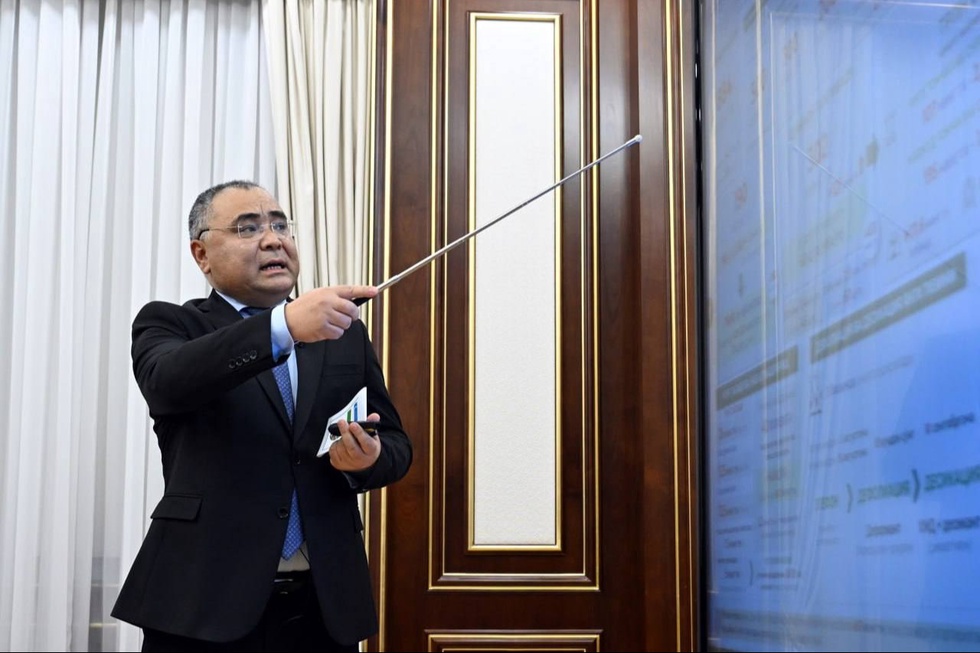
Agriculture holds an essential place in the country’s economy. The sector accounts for 20 percent of the economy, produces goods worth 467 trillion UZS annually, and provides employment for 3.5 million people. At the same time, fresh and processed agricultural products make up one-third of total exports.
The presentation detailed the issues of increasing productivity in cotton cultivation.
To this end, measures have been developed to work directly with low-productivity farms, introduce advanced agro-technologies and plant nutrition methods, and fundamentally reform the agronomist training system.
In particular, it was proposed to introduce a mentorship system in cotton growing, under which experienced farmers with yields exceeding 60 centners would be paired with farmers with yields below 30 centners.
Advanced farmers will undergo retraining at the Institute for Advanced Training and Retraining of Agricultural Personnel and will receive certificates upon completion. If low-productivity farmers achieve a yield of 50 centners per hectare, the farmers assigned to them as mentors will be awarded a monetary incentive of 5 million UZS.
To improve the agronomist training system, a two-year dual education mechanism will be introduced for graduates of the Agrarian University and other institutions that train agronomists. Students interning at leading clusters and farms will receive stipends, while the specialists who train them will receive incentive payments.
The presentation also included efforts to create local cotton varieties.
It was noted that Uzbekistan has two unique scientific institutions – the Center for Genomics and Bioinformatics and the Institute of Cotton Growing – yet their potential is not being fully utilized.
To further develop cottonseed production through varietal selection, instructions were given to build a phytotron and a reproduction greenhouse at these institutes. As a result, the time required to develop a new local variety will be reduced by 2.5 times, scientists’ work will accelerate, and the need for imported seeds will disappear.
Plans to scale up plastic-mulched cotton cultivation technology were discussed.
The President noted the importance of expanding the use of agro-drones and training specialists in this field.
The topic of introducing artificial intelligence technologies and digitalization in agriculture was also addressed. Information was presented on the work being carried out by the Ministry of Agriculture, in cooperation with foreign companies, to train personnel and create scientific infrastructure in this area.
Financial support measures were also discussed in detail.
It was proposed that, starting from 2026, a voluntary crop insurance system be introduced for cotton, grains, fruit, and legumes, with 50 percent of the insurance premium covered by the state budget.
To simplify the subsidy system, it was proposed to establish an Agricultural Payments Agency that would consolidate the 75 subsidy types currently provided by various government bodies onto a single platform. This will significantly reduce bureaucratic barriers and paperwork for farmers.
The President approved the proposals and issued the relevant instructions to the responsible officials.