
Rising in the global sustainability rankings.
In the 2025 Times Higher Education (THE) Impact Rankings, TSUL placed 301–400 globally and reached =51 worldwide for SDG 5: Gender Equality. The university also ranked 101–200 for SDG 8 (Decent Work & Economic Growth) and 201–300 for SDG 16 (Peace, Justice & Strong Institutions) and SDG 17 (Partnerships for the Goals), underscoring progress on social impact and governance goals.
Innovation recognized by WURI.
TSUL entered the Top‑200 of the World’s Universities with Real Impact (WURI) overall list and ranked in the Top‑50 for the “Fourth Industrial Revolution” category—acknowledging the university’s focus on modernizing legal education and research.
A new joint faculty with Roma Tre University (Italy).
TSUL and Roma Tre University have agreed to create a Joint Faculty in European Law at TSUL, delivering a curriculum aligned with European standards and deepening bilateral academic cooperation.
Regional leadership in professional ethics and arbitration.
In August, TSUL co‑hosted the Central Asia Legal Ethics Workshop with global law firm White & Case and PILnet—four days of applied training for more than 40 top law students from five countries, led by practitioners and academics from Europe, the U.S., and Central Asia.
In September, Prof. Dr. Islambek Rustambekov, TSUL’s Acting Rector, opened Uzbek Arbitration Week 2025, highlighting Uzbekistan’s growing role as a neutral, sophisticated regional arbitration hub and the responsible use of AI in dispute resolution.
Expanding access to justice through the Legal Clinic.
TSUL launched a Call Center at its Legal Clinic, allowing citizens to receive legal consultations via short numbers without visiting the clinic—an important step in widening access to legal aid. The clinic also won a grant from the Global Greengrants Fund’s Small Grants Program in Central Asia, supporting community‑focused initiatives.
Deepening international partnerships and mobility.
TSUL signed a cooperation agreement with the University of Szeged (Hungary) to expand staff and student exchanges, co‑host conferences, and develop joint degree options.
Engagements with Maqsut Narikbayev University (Kazakhstan) strengthened a long‑running dual‑degree program in International Law and featured guest lectures on international arbitration.
Students also benefit from mobility opportunities such as the University of Gdańsk (Poland) exchange program.
A track record of student and academic achievements.
TSUL’s momentum builds on a strong 2023–2024 baseline: participation in major grants (Erasmus+, DAAD and others), 120 students sent abroad on exchange and 75 faculty/staff on placements, and student success in international moots—Top‑48 globally at the Jessup and Top‑50 at the John H. Jackson competitions. Faculty produced 64 textbooks and 170+ teaching aids, while 28 foreign professors taught at TSUL over the year. (European Journal of Economics, Finance and Business Development, Mar. 2025).
Why it matters.
Together, these developments show a university investing simultaneously in global quality benchmarks, practical skills, and service to society—linking classroom learning to real‑world problem‑solving in Uzbekistan and across Central Asia. TSUL’s improved sustainability metrics, recognized innovation profile, and expanding international footprint position it to shape the region’s next generation of legal professionals.
About Tashkent State University of Law (TSUL)
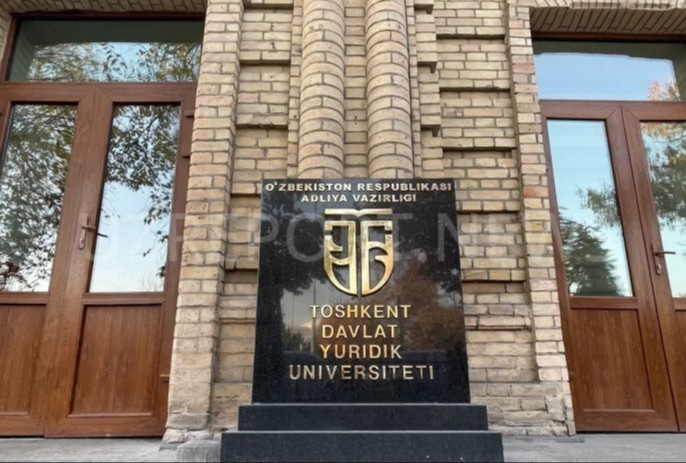
TSUL is Uzbekistan’s leading institution for legal education and research, with a growing portfolio of international collaborations and practical training programs that prepare graduates for public service and global practice. For more information, visit the TSUL newsroom.
By Shakhzoda Tuychieva,
Lecturer in Law at Tashkent State University of Law