
The decision is closely linked to the goals of the Uzbekistan 2030 Strategy and reflects the transition to a more disciplined, economically responsible and results-oriented model of public expenditure management.
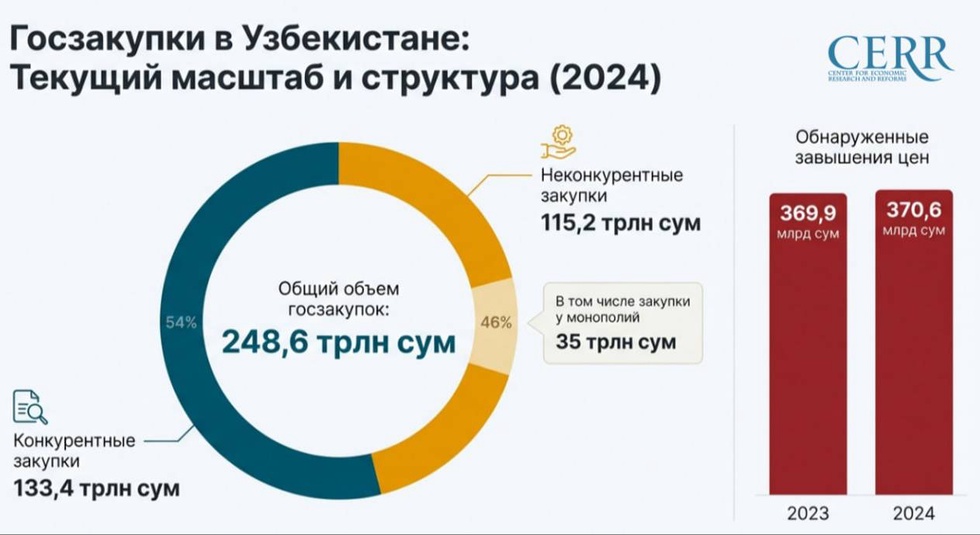
The key goal of the reform is to transform the public procurement system into a modern, service-oriented ecosystem that eliminates price gouging, opaque arrangements and inefficient costs. Today, the volume of public procurement in the country is 248.6 trillion soums, of which 133.4 trillion soums are for competitive procedures, and 115.2 trillion soums are for non-competitive ones, including 35 trillion soums for monopoly positions. In 2023, price overstatement was revealed in the amount of 369.9 billion soums, in 2024 - 370.6 billion soums. These indicators have become the basis for launching deep institutional and technological changes.
By 2030, it is planned to achieve the following targets: the share of competitive procedures will increase from 58% (2025) to 80%, budget savings from 14 trillion soums to 25 trillion soums, and the participation of entrepreneurs from 35% to 70%. The share of domestic goods and services in public procurement will increase from 68% to 85%, and the level of openness and ease of participation for businesses will increase from 60% to 98%.
One of the key elements of the reform will be the introduction of an electronic module for determining the average market price from March 1, 2026. Purchases with a deviation of more than 10% above or 20% below market parameters will automatically be classified as a high-risk area and subject to mandatory verification.
Starting from January 1, 2026, the list of 52 items of goods, works and services that allowed direct purchases will be canceled: 20 of them will be regulated by the Law on Public Procurement, 9 items will be completely excluded, 23 will be transferred to purchases in the "request for proposals" format.
At the same time, support for domestic producers is increasing: local electronic auctions are being introduced, cooperative mechanisms are being expanded, and localization at a level of at least 30% is being stimulated. Flexible financial conditions are provided - in some cases, prepayment is allowed within 15-30 days and an advance of up to 30%.
The e-procurement system is being significantly updated. In the "electronic store", the period of activity of offers will be 60 days, the processing period is 15 days, and the minimum delivery time is 5 days. For tenders, the deadline for examining documentation is set to 30 calendar days. An important rule is being introduced: even with the participation of one supplier, the auction is considered to have taken place; two-day lowering auctions will be used to lower the price. This is critically important considering that previously there were 6,000 tenders with only one participant.
The requirements for the discipline of procurement execution and resource management are being tightened. Goods cannot be stored in warehouses of government organizations for more than 3 months. A proactive audit is introduced at least once every 2 years, with mandatory submission of a report within 3 days. Public procurement plans must be published at least 3 business days in advance.
A separate block of reforms is devoted to system control and risk management. A unified classification of risks in public procurement is being introduced, a special page "Davlat xaridlarida nazorat" is being created, a KPI system for public procurement efficiency is being implemented, and annual reporting is being established by February 10.
In the future, this will make it possible to form a stable, predictable and fair system of public procurement, where each budget sum will work for the economic development of the country, improving the quality of public services and improving the living conditions of the population.
The Public Relations Sector of the CERR.