
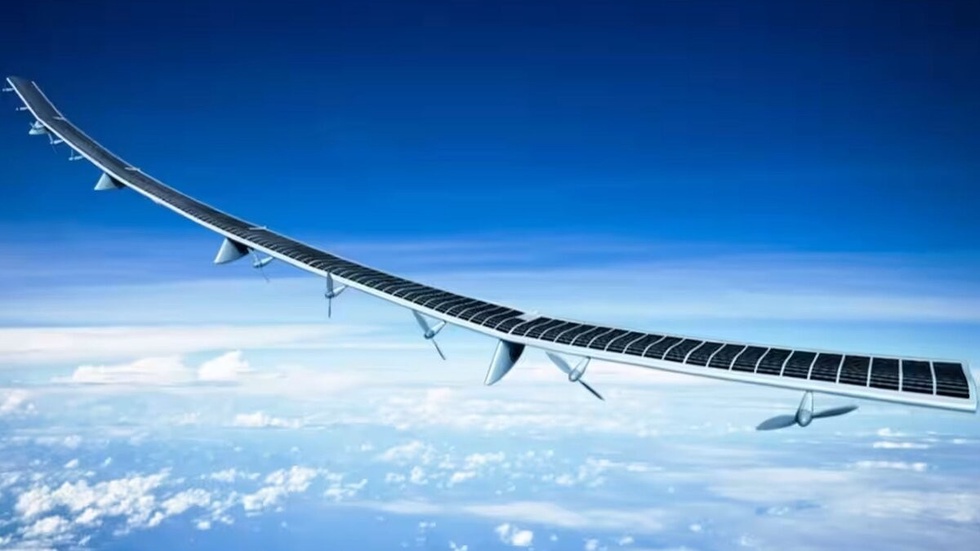
The most recent World Radiocommunication Conference, held from November through mid-December in Dubai, agreed to adopt four frequency bands as international standards for airborne base stations.
Japan proposed the four frequencies because they are used by high-altitude platform stations (HAPS), whose development is being driven by the Asian nation.
Airborne base stations will use the 1.7 gigahertz, 2 GHz and 2.6 GHz bands as global standards. The three frequencies form the core of cellular communications. The 700 to 900 megahertz "platinum" band, which allows for improved mobile services, will operate in Europe, Africa, the Americas and parts of Asia.
The HAPS unmanned vehicles fly at altitudes of 18 to 25 kilometers in the stratosphere to act like cellular base stations. They are considered next-generation telecom equipment that will expand connectivity up in the sky and at sea.
Japan has led the way in developing airborne base stations. In October, Japanese telecom group SoftBank Corp. said it successfully tested 5G transmission from the stratosphere via the aerial vehicles.
The connection enabled a video call between 5G smartphones in Rwanda and Japan, SoftBank said. The company is working with Rwanda's government on research toward rolling out the technology in Africa.
Space Compass, a joint venture between top Japanese telecom NTT and satellite broadcaster Sky Perfect JSAT, aims to offer commercial HAPS services for isolated islands and similar areas in the fiscal year beginning April 2025.
Over the next decade, Space Compass intends to invest tens of billions of yen (10 billion yen equals $70.2 million). Along with the two parents, Space Compass is working with wireless carrier NTT Docomo to accelerate development.
As of October, over 5.3 billion people globally use the internet, according to data provider Statista. That totals 66% of the world population, but penetration remains at 24% for eastern Africa and 28% for central Africa.
HAPS is seen as a next-gen solution to help bridge the digital divide. The agreement at the World Radiocommunication Conference will encourage Japanese business expansion overseas.
Japan envisions exporting the unmanned vehicles, telecom systems and operational management as a package. For HAPS to be introduced worldwide, technological criteria and certification regimes will need to be established in each market.
The World Expo 2025, to be held in Osaka, will demonstrate telecommunications with remote islands and other digital deserts using HAPS. By showcasing these achievements, Japan looks to compete with Western nations and China in developing infrastructure in the emerging world.
"For Japanese companies to establish a global presence, it's effective to narrow down fields where they excel in as well as markets, and make Japanese technology the de facto standard through public and private partnerships," said Narutoshi Sakano, director of the Center for Public Policy Research at the Fujitsu Research Institute.
Terrestrial base stations have coverage ranges of 3 to 10 km, while HAPS offers an estimated coverage of 200 km. This will give connectivity to areas normally hard to reach by regular base stations, such as islands and mountains. The drone stations will be useful in restoring communication during disasters.
The market for HAPS is set to more than double to $189 million in 2028 from $85 million this year, Indian research firm MarketsandMarkets reports.