

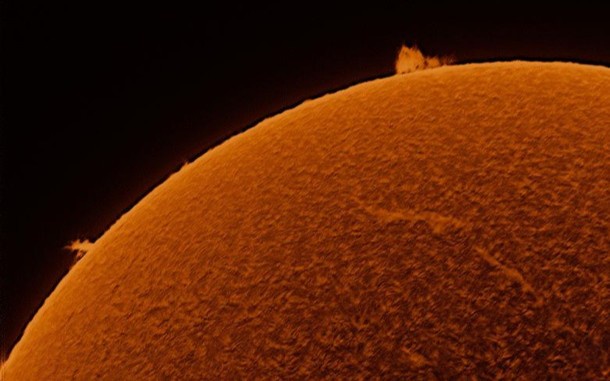
This was announced by the Laboratory of Solar Astronomy (XRAS) of the Space Research Institute of the Russian Academy of Sciences on Sunday, February 22.
"The star is a perfect disk without any special features," the report says.
According to scientists, the last time the Sun could be seen without a single spot was on December 11, 2021.
Experts note that "the complete disappearance of spots occurs only in a state of extremely low activity, usually during the years of the solar minimum."
"Yesterday, the flash activity index reached zero for the first time since 2024," the laboratory informs.
Scientists recalled that spots are almost an integral part of the surface of the Sun and are associated with the presence of a magnetic field – dark areas of the surface are formed in places with the highest concentration of magnetic flux. Since the energy for solar flares is drawn from magnetic fields, the number and area of spots correlate with the level of solar activity.
In history, there have been long (for several decades) periods of a sharp decrease in the number of sunspots. The most famous of these is the so–called Maunder Minimum, which lasted from 1645 to 1715 and coincided with the coldest phase of the Little Ice Age, a long era of abnormally cold and harsh winters in Europe and North America.
In the current situation on the Sun (just 1.5 years after passing the maximum of the cycle), the observed depression of activity cannot be prolonged and should end after a while. At the same time, the sharp drop in solar activity to the bottom, especially after an exceptionally stormy start to the year, was unexpected.
In January, the Sun experienced the largest magnetic storm in the last 20 years. It led to the appearance of the aurora borealis in the sky over some parts of the Earth. korrespondent.net.