
Many major projects are being implemented in the country across the industry, energy, infrastructure, and services sectors. New residential complexes, educational and medical institutions, and tourism and cultural centers are being built in every region.
Another result of such large-scale efforts and the dedicated work of the country’s creative people is Copper Processing Plant No. 3, which has strategic importance for the development of the national industry.
This project, valued at $2.7 billion and implemented on an area of 196 hectares within the framework of the development program of the “Yoshlik-1” deposit, represents not just an enterprise but a modern industrial complex that will strengthen the country’s industrial potential and contribute to ensuring the deep processing of its natural resources.
The plant, capable of processing 60 million tons of ore and producing about 900,000 tons of copper concentrate annually, is not only one of the largest copper production facilities in Central Asia but also ranks among the largest beneficiation plants in the world.
To implement the project in accordance with world standards, companies such as Wood from Italy and Worley Parsons from the United Kingdom were involved. The plant has introduced technologies from leading global companies – Metso, FLSmidth, Weir Minerals, and Siemens.
This project has also provided a strong impetus for the development of related industries in the region. The amount of metal structures used in construction is enough to build 10 Eiffel Towers, while the reinforced concrete used would be sufficient to construct 2.5 Burj Khalifa towers. This once again confirms that the plant is a megaproject.
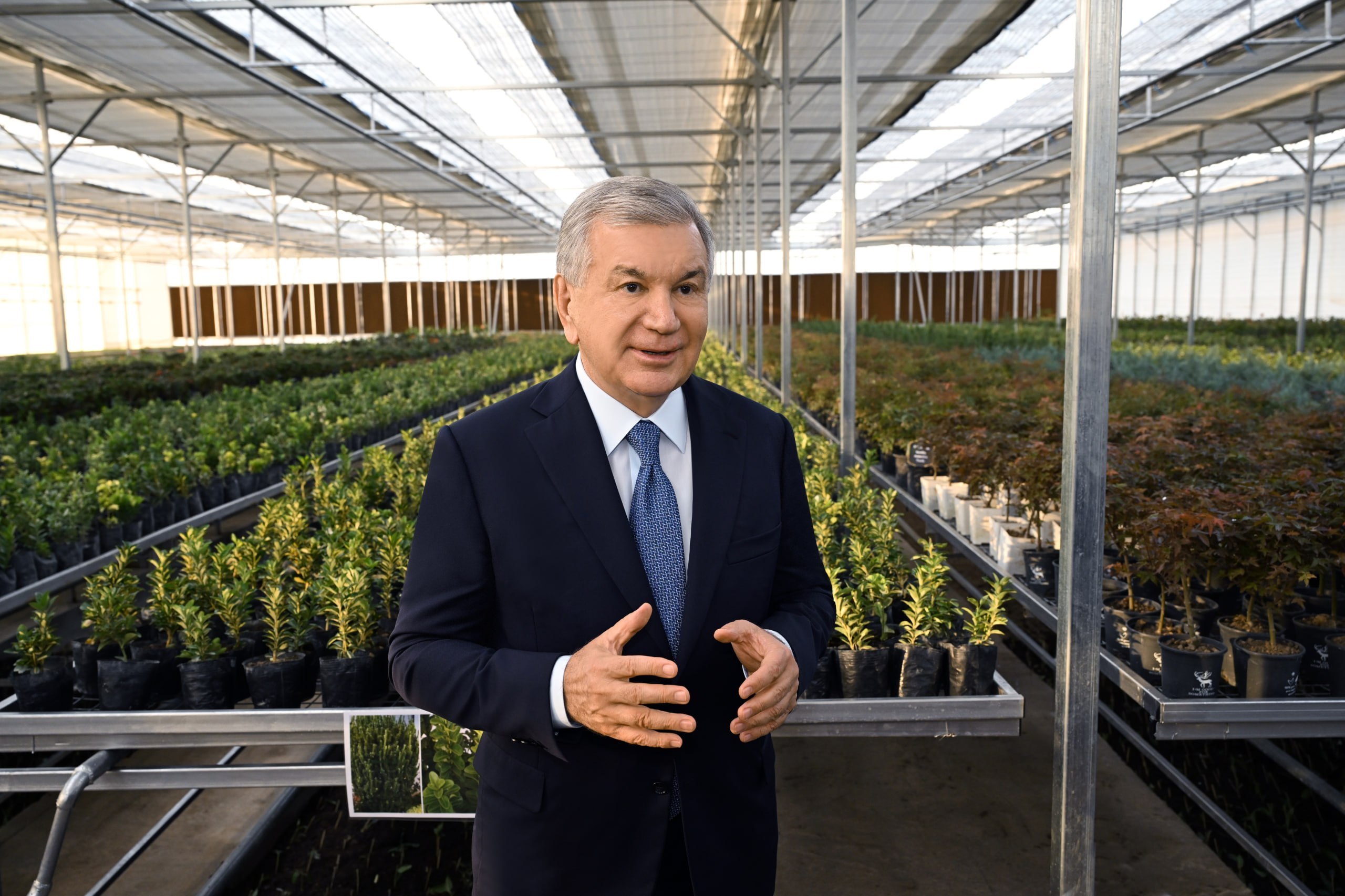
Within the framework of the nationwide “Yashil Makon” project, large-scale landscaping and greening works are underway on the plant’s territory. Drip irrigation systems and environmentally friendly design solutions are intended to ensure a balance between industry and nature.
In his speech, the President noted the results of reforms implemented in the mining industry in recent years and outlined plans for the future.
Thanks to the establishment of a transparent system for transferring deposits to investors, $10 billion in foreign investment has been attracted over the past nine years. Today, 65 private enterprises operate in this sector.
As a result, production in this industry has increased 1.7 times, reaching 270 trillion UZS last year. This sector accounts for a quarter of the country’s industrial output and budget revenues. Notably, the largest number of high-paying jobs is also created at enterprises in this field.
It was emphasized that one of the most significant achievements has been the establishment of training for highly qualified specialists in cooperation with foreign partners.
In particular, a branch of the Moscow Institute of Steel and Alloys, the Almalyk State Technical Institute, the University of Geological Sciences in Tashkent (in cooperation with the China University of Geosciences in Wuhan), and a branch of the University of Pisa in Italy have been established in Almalyk. The Navoi State University of Mining and Technologies has also launched joint programs with leading universities in Russia, Canada, the United States, France, and Chile.
As a result, whereas precious and non-ferrous metals were previously exported mainly in unprocessed form, today 100 thousand tons of copper are processed in the country, and high-value-added products are being produced. In a short period, jewelry industry production has increased 3.3 times and exceeded 13 trillion UZS.
The President noted that, taking into account the projects to be launched this year, the capacity for deep copper processing will reach 240 thousand tons. These figures are expected to continue growing through the implementation of new projects planned for the next two to three years.
It was emphasized that copper has become a strategic raw material for industry, energy, electrical engineering, the digital economy, artificial intelligence, and green development.
“Whoever builds a high-value-added chain in the copper industry will lay the foundation for the industry of the future. A country that creates a sustainable infrastructure for the deep processing of this raw material will bring income to thousands of families, development to regions, and strength to the state. Therefore, from the very first days of our reforms, we have paid special attention to geological exploration, identifying available reserves and our capabilities to utilize them”, said the Head of State.
This year alone, 20 million tons of ore will be extracted from the Yoshlik-1 deposit. Within the next two years, this figure will reach 60 million tons.
In general, it was noted that the Yoshlik-1 and Kalmakyr deposits contain reserves of 45 million tons of copper and more than 5 thousand tons of gold, which will provide the industry with guaranteed raw materials for at least 100 years. Such rare metals as molybdenum, selenium, tellurium, and rhenium, contained in these ores, provide a solid foundation for projects in new, innovative areas.
After Copper Processing Plant No. 3 reaches full capacity, the daily volume of copper concentrate production at the Almalyk Complex will increase from the current 2.4 thousand tons to 5 thousand tons. At the same time, more than 6,000 young people will receive high-paying jobs as part of the project. The plant is introducing the most advanced mining technologies from the United States, Germany, Russia, China, and Finland. All technological processes will be digitized and integrated into a unified management system based on artificial intelligence. As a result, energy consumption will decrease by 10 percent, production costs by 15 percent, and labor productivity will increase by 10 percent.
In addition, construction work has begun on a new copper smelting plant valued at $2.5 billion.
Overall, it was emphasized that thanks to these two major facilities, the annual production of copper cathodes will increase from 148.5 thousand tons to 300 thousand tons, gold from 20 tons to 33 tons, silver from 161 tons to 203 tons, and molybdenum from 850 tons to 1.7 thousand tons. At the same time, the production of sulfuric acid – a raw material indispensable in uranium mining and the chemical industry – will triple.
The President noted that pre-project work on Copper Processing Plant No. 4 is being carried out at an accelerated pace, enabling an increase in these indicators by 1.5 times.
Uzbekistan plans to increase gold production to 175 tons, silver to 500 tons, uranium to 15,000 tons, and copper to 500,000 tons by 2030. Nearly 40,000 high-paying jobs will be created through projects worth $22 billion, providing significant opportunities for the country’s youth.
The Head of State expressed deep gratitude to all those who actively participated in the construction of the plant – builders and mechanics, engineers and technologists, geologists and miners, labor veterans who shared their experience and professional expertise with the younger generation, as well as foreign partners who contributed to the project. He wished the plant’s new team great success in their future work.
A conversation was held with the plant’s workers, labor veterans, and professors.
Following the ceremony, the Head of State pressed a symbolic button and officially launched the plant’s operations.