

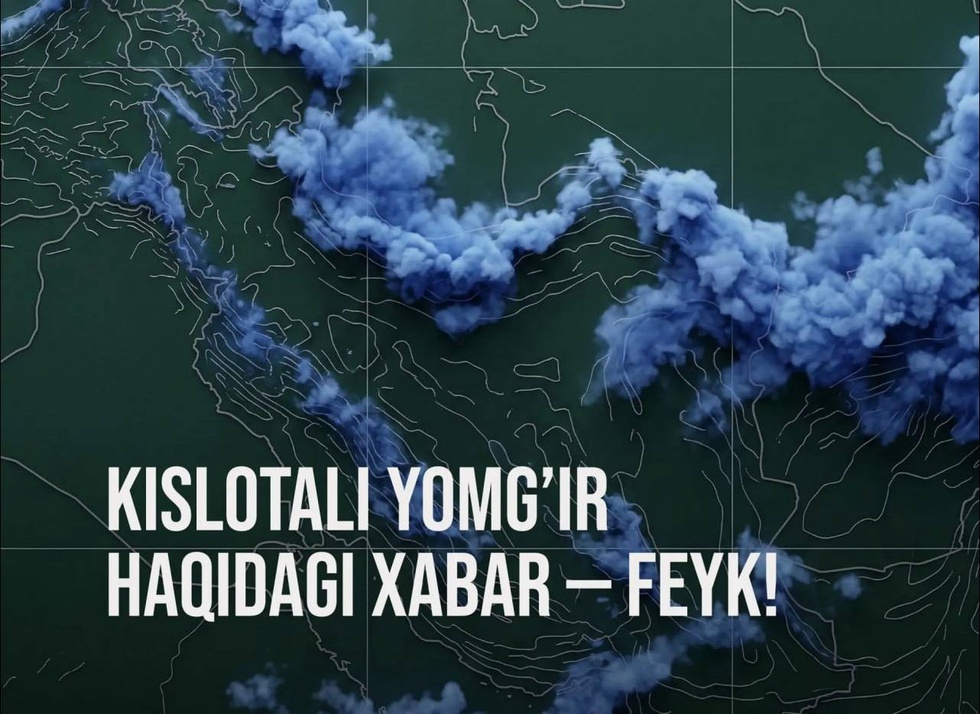
According to the National Committee on Ecology and Climate Change of the Republic of Uzbekistan, acid precipitation is formed during prolonged accumulation of sulfur oxides (so₂) and nitrogen oxides (noₓ) in the atmosphere. In clouds, these substances enter into chemical reactions with water vapor, which leads to the formation of acidic compounds.
Such processes are typical primarily for industrial areas and areas of direct emissions of pollutants. When air masses are transported over long distances, the concentration of pollutants decreases sharply due to atmospheric turbulence, vertical mixing, and dry and wet deposition.
Therefore, the formation of dangerous concentrations of acid precipitation at a distance of thousands of kilometers from the source is almost impossible.
In addition, precipitation is determined by local cloud formation processes. Rain is formed from water vapor and aerosols located directly in the atmosphere above a particular region.
According to meteorological observations and air quality monitoring, there is no threat of the transfer of "acid clouds" to the territory of Uzbekistan and neighboring countries.