
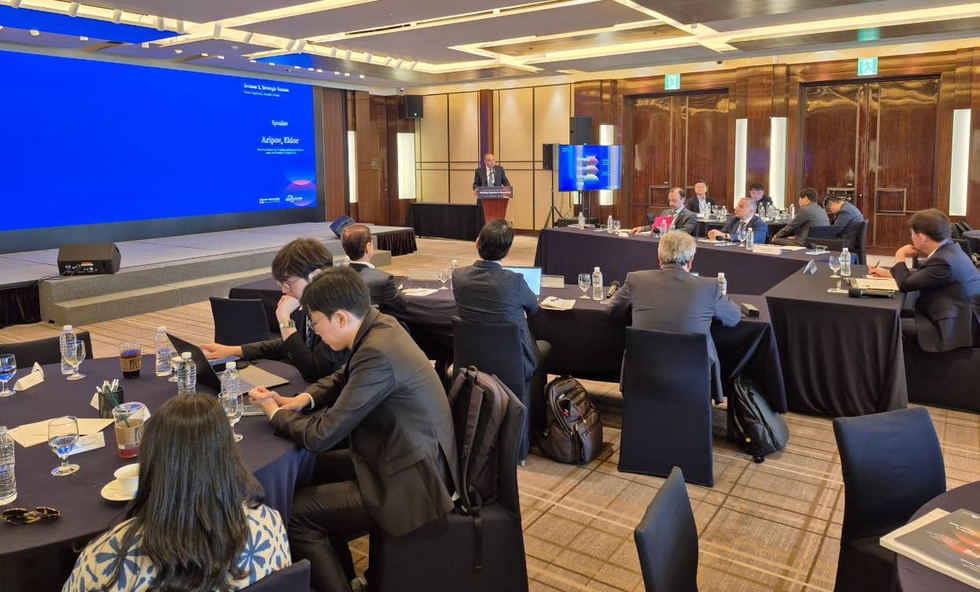
This year's forum is dedicated to the theme "For peace and prosperity: overcoming conflicts through solidarity in the face of the return of global competition of Powers."
The event, organized by the Center for International Regional Studies at Hankook University of Foreign Languages (CIAS), is attended by representatives of analytical centers and academic circles from Central Asia, the CIS, the European Union, the United States, Turkey, the Asia-Pacific region and South Asia.
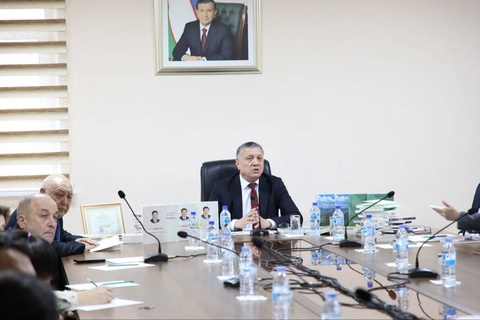
Speaking at a session on public diplomacy, E.Aripov noted that in conditions of increasing geopolitical uncertainty, mechanisms for building trust between states and peoples are becoming particularly relevant.
In this regard, the head of the ISMI presented the experience of Central Asia, where it was possible to ensure a qualitative breakthrough in the development of regional cooperation. He stressed that thanks to the political will of the leaders of the region's states, conditions were created for resolving most of the accumulated contradictions, expanding cross-border cooperation, and creating an atmosphere of mutual trust.
According to E.Aripov, today the region demonstrates high dynamics of political and economic cooperation. In recent years, the volume of intraregional trade has increased almost fivefold, and mutual investments have more than doubled.
Special attention was paid to public diplomacy in strengthening the achieved results. As the Director of the ISMI noted, sustainable peace and stability are impossible without the active participation of local societies. The expansion of people-to-people contacts, the development of cross-border trade, tourism, educational and cultural exchanges contribute to the formation of an atmosphere of trust, which is an important factor in the further development of the region.
Consultative Meetings of the Heads of State of Central Asia, the Interparliamentary Forum of Central Asian Countries, the Dialogue of Women Leaders of Central Asia, the Forum of Rectors of Central Asian Universities, the Forum of Historians and Regional Scholars, as well as the Central Asian Youth Forum were presented as practical mechanisms for strengthening regional connectivity. The initiative to create an international media platform "History and Culture of Central Asia: one past and a common future", aimed at promoting the common historical and cultural heritage of the peoples of the region, was also highlighted.
Speaking about Uzbek-Korean relations, E. Aripov stressed that the Republic of Korea is one of Uzbekistan's key partners in Asia. He noted that humanitarian ties are an important basis for bilateral cooperation, which in 2019 was brought to the level of a special strategic partnership. By the end of 2025, the volume of mutual trade approached $ 2 billion.
According to the head of the ISMI, an important factor in strengthening Uzbek-Korean relations remains the largest Korean diaspora of Uzbekistan in the CIS, numbering about 177,000 people, which makes a significant contribution to the development of friendly relations.
E.Aripov also noted the high pace of cooperation in the educational and scientific fields. Today, the Korean language is studied in 9 universities and 24 schools in Uzbekistan. There are 4 branches of South Korean universities in the country, and domestic higher education institutions maintain partnerships with more than 45 universities and research centers in the Republic of Korea.
Concluding his speech, the Director of ISMI emphasized that the experience of Central Asia clearly demonstrates the effectiveness of the policy of good neighborliness, open dialogue and mutual consideration of interests. In his opinion, the further development of public diplomacy and humanitarian ties is in line with the objectives of strengthening peace, stability and sustainable development both in Central Asia and in the wider Eurasian space.