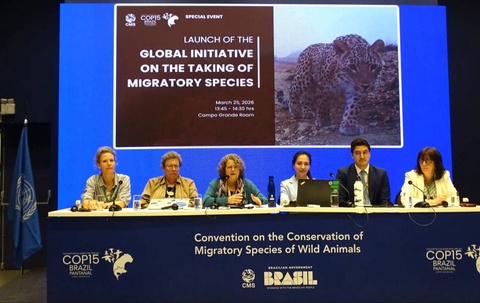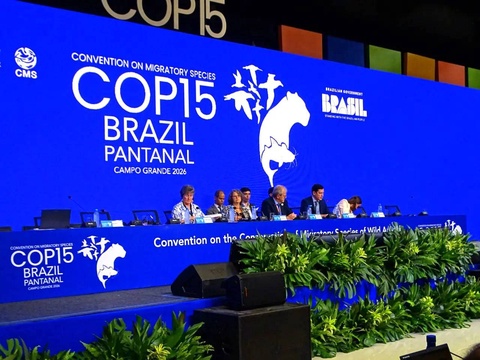

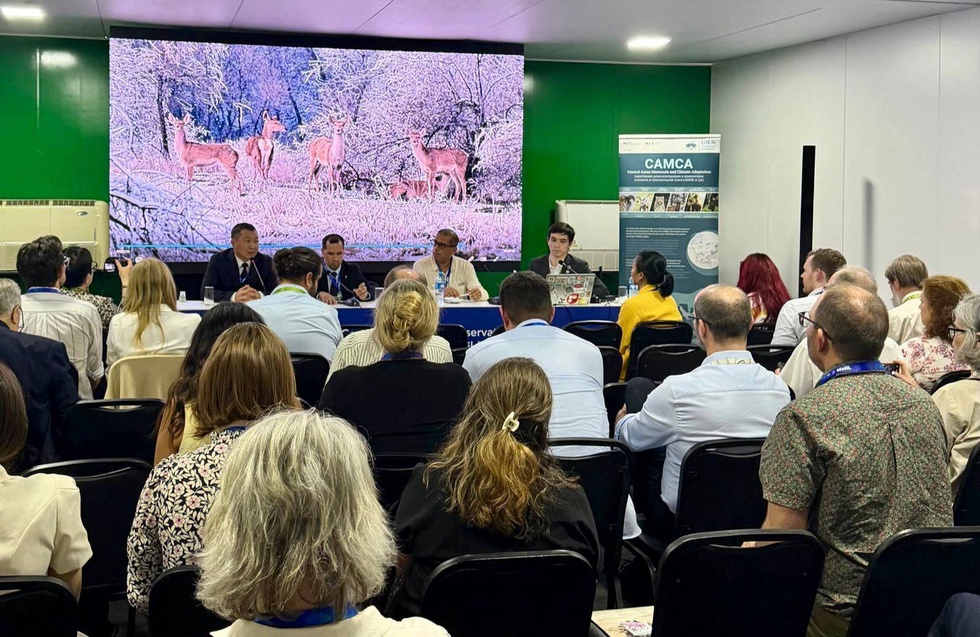
The purpose of the event was to promote regional cooperation on the conservation of migratory mammals in Central Asia, discuss the implementation of the Central Asian Mammal Initiative (CAMI), and present new approaches to the conservation of species and their habitats.
The side event was organized by Uzbekistan and highlighted the country's leading role in the implementation of the regional environmental agenda and the development of cross-border cooperation within the CMS.
CMS Executive Secretary Amy Frenkel and Vice President of the Wildlife Conservation Society Susan Lieberman noted the importance of CAMI as a key regional mechanism for coordinating efforts to preserve biodiversity.
Natalya Marmazinskaya, Deputy Director for Science of the Zarafshan National Nature Park, was the key speaker from Uzbekistan. In her speech, she presented the new CAMI work program for 2026-2032, based on a territorial approach and the allocation of priority transboundary environmental regions.
Special attention was paid to the practical results of Uzbekistan. In particular, the recovery of the Bukhara deer population was noted: its number increased from about 2,780 individuals in 2015 to more than 5,000 individuals in 2025, which was the result of consistent measures to protect, monitor and manage the population.
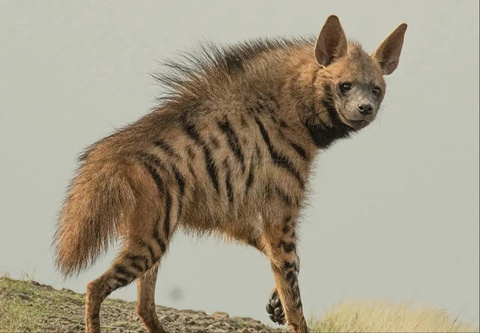
A separate block presented the joint initiative of Uzbekistan and Tajikistan to include the striped hyena in Annexes I and II of the CMS. The report was presented by NABU representative Joshua Schluter, justifying the need for international coordination of efforts to preserve the species, whose numbers are declining and are estimated at less than 10,000 individuals.
During the panel discussion, international experts discussed issues of sustainable pasture management and their impact on the conservation of migratory species, including saiga, as well as the need to strengthen global biodiversity conservation policies.
Concluding the event, the participants emphasized that Uzbekistan, acting as the chairman of CAMI for the period up to 2032, plays a key role in shaping the regional agenda, strengthening cross-border cooperation and integrating environmental initiatives into national and international strategies.
The side event demonstrated the high level of Uzbekistan's involvement in global environmental processes and confirmed its status as one of the leaders in the field of biodiversity conservation in Central Asia.