
The purpose of the events is to strengthen both strategic cooperation and work at the forefront in ending human trafficking.
"Protecting victims and preventing human trafficking requires both strong policies and well-trained professionals," said Cary Johnston, OSCE Special Representative and Coordinator for Combating Human Trafficking. - The ongoing reforms in Uzbekistan create a solid foundation, and targeted professional development activities, especially on combating human trafficking using technology, help turn commitments into effective actions in practice.
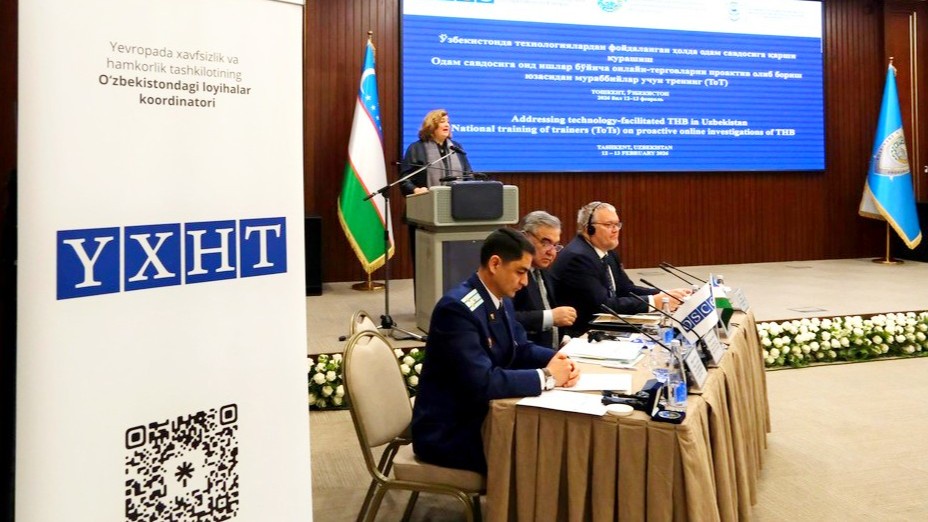
The training course held at the Law Enforcement Academy of the Republic of Uzbekistan brought together participants from relevant government institutions, including the Law Enforcement Academy, the Prosecutor General's Office, the Ministry of Internal Affairs, the Academy of the Ministry of Internal Affairs, the Ministry of Digital Technologies, the Commissioner for Children's Rights and the State Labor Inspectorate.
The course was based on the OSCE training program on investigating cases of human trafficking using technology. The training is aimed at strengthening skills in dealing with this complex form of exploitation. The program is designed to provide participants with the necessary knowledge to identify, investigate, and prevent exploitative practices that are increasingly being used to target vulnerable populations, including online recruitment schemes, abuse of messengers and social networks, and the use of artificial intelligence.
"The training course provides law enforcement officers with specific skills in conducting proactive online investigations, working with open sources of information and a victim-centered approach, and helps law enforcement educational institutions adapt teaching methods to counter human trafficking carried out using technology," said K. Johnston.
Participants gained in-depth knowledge about investigating cases of human trafficking using technology, and also learned how to combine investigative methods, case-based training, and a victim-centered approach in training specialists. They also learned how to conduct these modules for both active law enforcement officers and cadets, which allows them to increase knowledge and enhance the ability of law enforcement agencies to identify online recruiting tactics, investigate digital exploitation and prevent methods of control by criminals in the virtual space.
"The OSCE continues to support Uzbekistan's comprehensive approach to combating human trafficking," said Ambassador Antti Karttunen, OSCE Project Coordinator in Uzbekistan. - By investing in the training of law enforcement officers and introducing modern investigative tools, Uzbekistan is strengthening its capabilities to prevent human trafficking, protect victims and effectively respond to new methods of criminals - especially those increasingly associated with digital technologies.
In addition to conducting training, during the visit of K. Johnston met with a number of high-level participants in anti-trafficking initiatives. K. Johnston noted Uzbekistan's successful experience in this area and discussed ways to further develop, expressing support for the country's efforts, including recent legislative reforms: amendments to the Criminal Code, toughening penalties for trafficking in persons, as well as a new law aimed at protecting children from all forms of violence.