
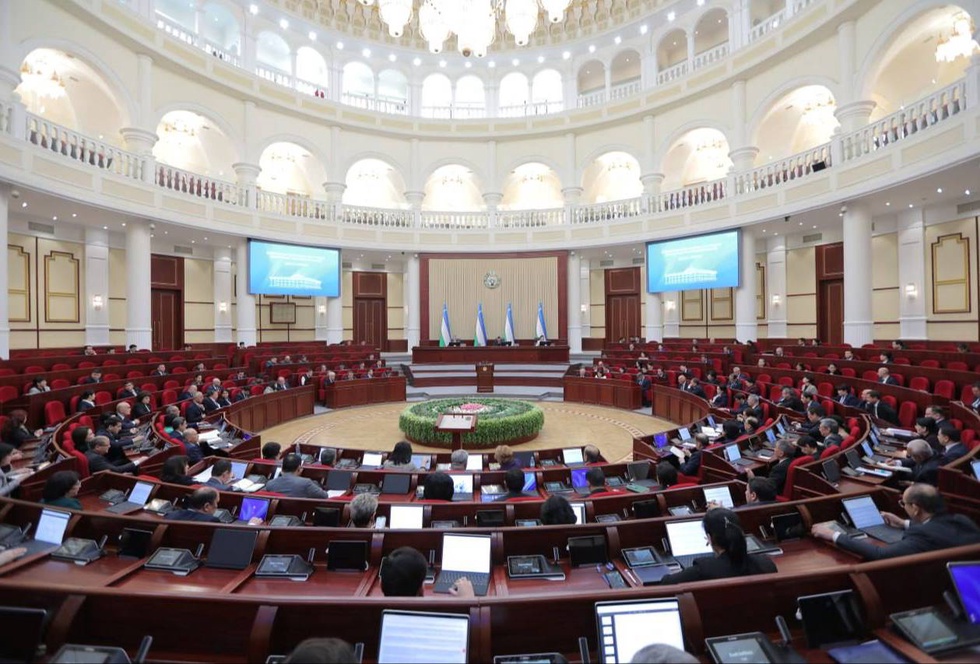
To organize effective probation supervision
First, at the meeting, the draft law "On amendments and additions to certain legislative acts of the Republic of Uzbekistan aimed at improving control mechanisms for persons released on parole from serving their sentences" was considered in the second reading.
It is noted that in recent years, work has been systematically carried out in the country to form law-abiding behavior and respect for the rules of behavior in society among persons under probation supervision.
Along with this, in practice, a number of issues arise related to the lack of clearly defined mechanisms for monitoring the fulfillment by persons released on parole from serving their sentences of the duties assigned to them by the court. This, in turn, requires legislative regulation of relevant relations in this area.
The draft law provides for the introduction of appropriate amendments and additions to the Criminal, Criminal Procedure and Penal Enforcement Codes, as well as to the Law on Probation, which defines clear legal procedures for probation supervision of persons released on parole from serving their sentences.
In particular, the procedure for revoking conditional release and sending persons who have failed to fulfill obligations established by the court to serve their sentences or impose additional obligations on them is established. Along with this, it provides for the possibility of submitting to the court a submission on the partial or complete cancellation of the assigned duties in relation to persons who responsibly fulfill their obligations.
The adoption of this draft law will serve to effectively monitor the behavior of persons released on parole from serving their sentences, apply effective measures of influence to persons who do not comply with court requirements, strengthen law-abiding, as well as prevent offenses and repeat crimes.
The draft law was adopted by the deputies in the second reading.
The procedure for recognizing rights will be accelerated
After that, the deputies considered the draft law "On amendments and additions to certain legislative acts of the Republic of Uzbekistan" in the second reading, article by article.
This bill is aimed at further accelerating the work on the recognition of rights to illegally seized land and buildings and structures built on them.
The draft law proposes amendments and additions to the Laws "On the Recognition of Rights to illegally seized land and buildings and structures built on them" and "On the State Registration of Rights to Immovable Property."
In particular, it provides for shortening the time for reviewing documents related to the recognition of rights, determining the procedure for entering data into an automated information system, clarifying the concept of tax arrears, establishing the procedure and conditions for making a lump sum payment in installments for recognizing the right to lease land, as well as improving the mechanisms for reviewing complaints related to the recognition of rights.
In addition, in order to eliminate duplicate norms related to the concept of "tax debt", a separate definition of debt is introduced into the basic concepts: land tax, property tax — in relation to buildings and structures erected on it. In this case, the tax debt is determined by the amount exceeding thirty times the basic estimated amount.
It was noted that the norms stipulated in the draft law are aimed at eliminating factors that hinder the recognition of the rights of individuals and legal entities to real estate, and, most importantly, at ensuring human interests.
After a long debate, the bill was passed by the deputies and sent to the Senate.
The legal basis for providing high-quality medical services to the population
In the second reading, a draft law was considered aimed at improving the system of providing services included in the guaranteed volume of medical care to the population, as well as the procedure for carrying out professional activities of medical and pharmaceutical workers.
The draft law provides for the introduction of additions and amendments to the Laws "On Public Health Protection" and "On Medicines and Pharmaceutical Activities", according to which the types of medical care related to additional services provided in primary health care institutions are defined, as well as the right of persons who have passed state registration to carry out medical and pharmaceutical activity.
In particular, it is established that medical and other services provided in primary health care institutions in excess of the guaranteed amount of medical care will be considered additional and provided on a fee basis. Medical care provided to citizens who have applied without the referral of a family doctor or medical team also applies to additional services, with the exception of cases of emergency and emergency medical care.
In addition, the draft law strengthens the legal framework for the introduction of an innovative model of healthcare management, as well as state registration of medical and pharmaceutical workers.
In particular, it is determined that the right to carry out medical or pharmaceutical activities will be granted to persons who have a corresponding diploma of higher or professional education in the field of medicine and have passed state registration. In this case, when issuing a diploma of higher or professional education in the medical field, it is subject to state registration based on the results of the final state certification.
According to the responsible committee, in the process of preparing the draft law for the second reading, it was finalized taking into account the proposals of the members of the working group and deputies.
The adoption of the defined standards will serve to effectively ensure the right of citizens to receive high-quality medical care, the introduction of an innovative model of healthcare management, as well as the prevention of medical and pharmaceutical activities by persons who do not meet the requirements of legislation and qualifications.
After heated discussions, the bill was adopted by the deputies and sent to the Senate.
The powers of government bodies in the field of cultural heritage are being clarified
In the first reading, the deputies considered a draft law aimed at legally consolidating the powers of the Cultural Heritage Agency.
It was noted that as part of the administrative reforms being implemented in the country, the system of public administration in the field of cultural heritage is being consistently improved. In particular, the structure, tasks and functions of the republic's executive authorities operating in this area are being reviewed, with attention being paid to improving their work efficiency.
At the same time, the presence in the current legislation of duplication of powers of ministries and departments, some contradictory norms and legal gaps necessitates the formation of a clear and unified legal approach in this area.
The draft law provides for specifically defining, systematizing and bringing the powers of the republic's executive authorities in the field of cultural heritage in accordance with the law by making appropriate amendments and additions to a number of legislative acts.
In particular, the powers of the Ministry of Culture and the Cultural Heritage Agency in the field of protection and use of tangible and intangible cultural heritage sites are clearly distinguished. The authority to conduct archaeological research, historical and cultural expertise, state cadastre, museum activities, as well as the export and import of cultural property is assigned to the Agency.
It was emphasized that the adoption of this draft law will serve to strengthen the institutional system of public administration in the field of protection and rational use of cultural heritage sites, eliminate contradictions and legal gaps in legislation, as well as increase the effectiveness of authorized bodies.
After a long debate, the bill was passed by the deputies and sent to the Senate.
Activities in the field of hunting and hunting farms are being improved
At the meeting, a draft law aimed at improving activities in the field of hunting and hunting farms was considered in the first reading.
The draft law is aimed at systematizing the procedure for hunting and training hunters, introducing advanced technologies into the industry, preserving and reproducing biodiversity in hunting farms, as well as developing the infrastructure of hunting tourism.
The document provides for the introduction of appropriate amendments and additions to the Laws "On Weapons" and "On Hunting and Hunting farming." This draft law is aimed at clearly regulating hunting processes, systematizing the activities of hunting farms, protecting wild animals and creating favorable conditions for their natural reproduction.
The draft law reflects the norms aimed at increasing the transparency of hunting processes. In particular, it provides for the issuance of hunting permits (wild animal capture cards) through a special electronic system, on the basis of which the right to seasonal or one-time hunting is granted.
In addition, the practice of releasing wild animals raised in nurseries into hunting grounds is supported, and permission for organizing hunting at the expense of such animals is also determined. This approach allows you to simultaneously hunt and replenish the population of wild animals.